Showing posts with label fire protection. Show all posts

Thursday, 27 October 2016

Fancy dresses and flaws in flammability requirements

After reading a sign in the local charity shop, I watched this excellent 2015 BBC One investigation piece on textile flammability requirements for children's fancy dresses. It was produced after the daughter of TV presenter Claudia Winkleman was badly injured in 2014 because her fancy Halloween dress got on fire. 

BBC One found that fancy dresses had been classified as children toys and not as children’s clothing for fire safety requirements. Toys have to pass a much less onerous flammability test than children’s clothing. Hence the danger, because fancy dresses are in close proximity to the body and can be very flammable due to the fluffy arrangements of synthetic and thin fabrics.

"Flammable fancy dress clothing", watch it here.

"Flammable fancy dress clothing" by BBC One.


There are three things that I would like to highlight about this case:

1) This safety flaw in the flammability requirements is born from the wrong trade classification of the consumer product, not from a lack of understanding of the fire hazard. Now that this is known, it should be easy to rectify.

2) The response of national retailers in 2015 was overwhelming. The BBC lists the responses of 12 major companies (eg, John Lewis, Mothercare, Toys ‘R’ Us) which revisited the safety of their products. Some of them (Fara Kids, for example, see photo from our local shop below) even stopped selling fancy dresses altogether.

3) The industry response has been towards increasing flammability requirements of fancy dresses and match the higher requirements of children’s nightwear. I say this because there are current pressures asking to downgrade flammability requirements of consumer products (eg, sofas in California).

Photo of the sign in our local charity shop.

Monday, 21 March 2016

The Fire Navigator: smoke and flame sensors in smart buildings

The Fire Protection Engineering magazine has recently published our article reporting exciting research on the theme of smart buildings and fire protection. In this work, sponsored by Chief Donald J. Burns Memorial Research Grant, my student Nahom and I developed an algorithm that uses data arriving from building sensors to detect and map an ongoing fire. The algorithm, called the Fire Navigator, then provides forecasts of future smoke and flame spread within the building, allowing to see where and how the fire would propagate if not stopped before hand.


We envision that the forecasting of fire dynamics in buildings will lead to a paradigm shift in the response to fire emergencies, providing the fire service with essential information about smoke propagation and flame spread ahead of time (i.e. minutes before it happens). Disposing of information on fire events before they actually happen would have a positive effect on the fire service efficiency and safety, therefore saving human lives and mitigating property losses and environmental damage. Smart buildings anticipate the occupants’ needs with the help of various sensors. Control of heating and air conditioning, energy consumption and lighting are now common examples of how sensors allow control over key aspects of the built environment. We want to extend this to fire safety engineering and enhanced fire fighting. Already existing smoke and heat sensors, as well as sprinklers, generate data that has yet to be harnessed and used in smart buildings. This is what our article proposes and shows how to do it.

Our work is based on combining new and old ideas. The new ideas are the use of a very quick fire model based on cellular automata theory, and the integration of  the whole system into building information models (BIM). You can read the full article at the SFPE website:

The Fire Navigator: Forecasting the Spread of Building Fires on the Basis of Sensor Data 


NOTE: This research was sponsored by SFPE and Bentley Systems via the Chief Donald J. Burns Memorial Research Grant. We thank Arup, specially Judith Schulz, for sharing their expertise in BIM and fire protection systems, and thank KPF for permitting the use of their architectural BIM models.

Sunday, 16 August 2015

PhD Studentship in Heat Transfer at Imperial College London

Applications are invited for a PhD studentship in the field of heat transfer and artificial intelligence funded by EPSRC and Arup.


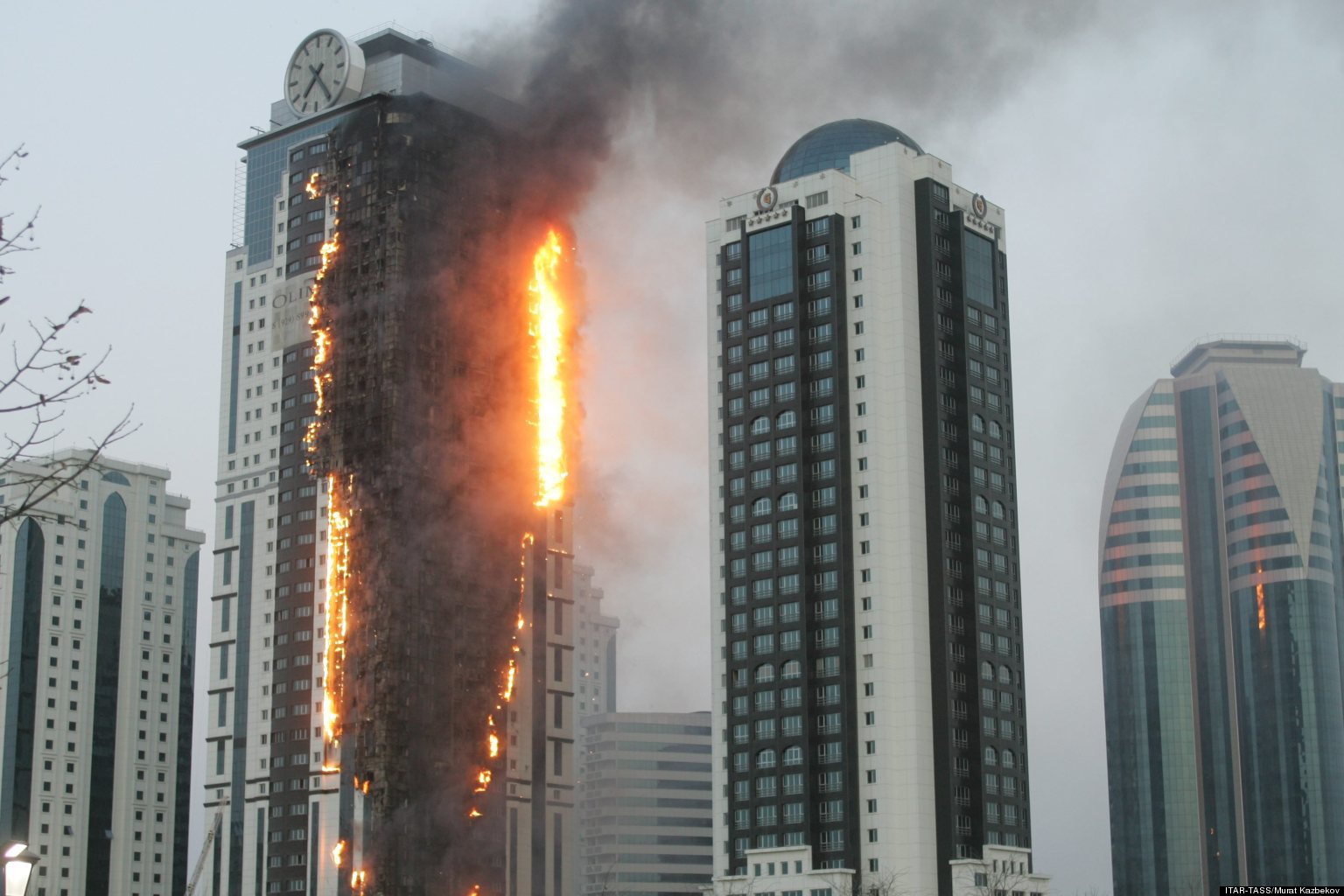
2013 facade fire in Grozny. Photo from huffingtonpost
The research project, named INERSKIN, will develop a toolkit for fire safety optimisation of building façades. With a drive for thermally efficient buildings and sustainability, flammable insulation materials like polymers are more frequently introduced in the design of façades system. Because of the importance of façades and the increasing number of high rise buildings worldwide, it is critical that the interaction of materials and their performance in the event of a fire is understood, modelled and improved. INERSKIN will use artificial intelligence techniques and the state of the art of computational heat transfer to optimize their fire safety.

The student will join the Hazelab, the multidisciplinary research group led by Dr Guillermo Rein and part of the Thermofluids Division in the Department of Mechanical Engineering. The purpose of the group is to reduce the worldwide burden of accidental fires and protect people, their property, and the environment. To do so, Hazelab studies computationally and experimentally heat transfer processes, condensed-phase chemistry and thermodynamics of reactive solids.

You will be an enthusiastic and self-motivated person who meets the academic requirements for enrollment for the PhD degree at Imperial College London. You will have a degree in engineering or physics, and an inquiring and rigorous approach to research together with disciplined work habits. Interests in heat transfer and artificial intelligence are essential. Good team-working and communication skills are essential. Knowledge in fire science and building design are encouraged but not essential prior the project.

Candidates should fulfill the eligibility EPSRC criteria for stipend and fees (UK resident for at least 3 years). Please check your suitability at the following web site: http://www.epsrc.ac.uk/skills/students/help/Pages/eligibility.aspx

For further details of the post, contact Dr Guillermo Rein g.rein@imperial.ac.uk with up-to-date curriculum vitae.

Closing date: 30th April 2016.

Monday, 27 July 2015

Improved travelling fires for structural design

The collapse of 1WTC, New York City, 10:28am Sept 11, 2001.
Photo by
9/11 Photos CC BY.
Our latest paper on travelling fires for structural design has been published in Structures (journal of IStrutE) with the title Improved formulation of travelling fires and application to concrete and steel structures.

Note: It is open access so you can read and share it without need for a subscription. We have posted in open access also our Matlab code to calculate the fire temperatures in zenodo.


Accidental fire can be disastrous, especially in buildings. The effect of fire on structural stability is critical in regard to safe evacuation and safe access for fire fighters, financial losses, and lost business. This is particularly the case in tall buildings where extended evacuation times are required due to phased evacuation practices. The World Trade Centre Tower fires in 2001 have highlighted the need of a more realistic design tools to represent fires in large compartments. 

Innovative architectural designs of modern buildings already provide a challenge to structural engineers. This is above all the case in structural fire engineering. However, most of the understanding and current design codes are based on the assumption of uniform fires in a compartment. In previous work, we have shown that fires in large, open-plan compartments, typical of modern architecture, travel from one part of it to another with non-uniform temperature distribution. These fires are referred to as travelling fires. And Travelling Fires Methodology (TFM) has been developed to account for the travelling nature of fires.

Illustration of a travelling fire and distribution of gas temperatures.
TFM was born in 2010 and offers a paradigm shift in the structural engineering of modern buildings. The concept has already been applied by engineering firms like Arup, BuroHappold or AECOM in the design of a dozen of iconic buildings in the UK (including the renovation of Battersea Power Station in London). TFM accounts for one of the fastest knowledge transfers from research to industry seen in fire protection engineering. TMF is now being studying in detailed in the USA for possible adoption as well.

The focus of this latest paper is on the improvement of the calculations of traveling fire (iTFM) to account for better fire dynamics, and the analysis of the effect on structural members. The proposed changes represent a simple yet powerful fire model. In particular, our paper shows that:
  • Using data from experiments and real fires, we limit the range of possible fire sizes thus reducing the time required for conduct TFM studies.
  • Analytical expressions are presented for generating time–temperature curves which are independent of grid size (previous versions of TFM) and can be easily calculated with any mathematical tool. 
  • Introduction of flapping term leads to reduced near-field temperatures for smaller fire sizes which cover a range between 800 and 1200 °C, as observed in real building fires. 
  • The location of the peak temperature in the compartment is found to occur at the end of the fire path (i.e. far half of the compartment from the ignition source).

Wednesday, 13 May 2015

Welcome Virginia to Imperial Hazelab

Dr Virginia Alonso has joined the Department of Mechanical Engineering at Imperial College London as postdoc in my research group, Imperial Hazelab.

Virginia is from Santander, beautiful city in the North of Spain. She graduated with an MSc in Physics and an PhD in Fire Evacuation Modelling at University of Cantabria, Spain, as member of the GIDAI group. She has also been a visiting scholar at the National Fire Protection Association (NFPA) and National Institute of Standard and Technology (NIST).

At Hazelab, she is involved in the project N-LAYERS to conduct a study and write a white paper where a holistic view of fire protection engineering is created, and the role of prevention is examined. Fire safety is made of a series of layers (e.g., prevention, fuel control, passive and active systems, evacuation, and structural response). All layers have a role in fire safety, but not all layers are equally important, effective or costly. In this project, Virginia aims to study in-depth the role of prevention in a systemic view of fire protection.