Showing posts with label PhD. Show all posts

Tuesday, 27 October 2015

Our Student at the Royal Welcome of Chinese President

I was delighted to learn that my PhD student Xinyan Huang attended the Royal Welcome and Honour Guard Inspection held by Queen Elizabeth II for the Chinese President Xi Jinping. This is a traditional ceremonial welcome to foreign leaders visiting the UK. It took place last Tuesday near Buckingham Palace with the presence of senior royal family members and political leaders.

Xinyan was invited by Lord Chamberlain. There were 80 guests, 40 Chinese and 40 British. He was invited as one of three students representing the 150,000 Chinese students in UK. An important factor for being chosen for the honor is that Xinyan was the only student from Imperial College winning the 2014 National Award for Outstanding Chinese Student Studying Abroad given annually worldwide by the China Scholarship Council.
 
Xinhua media describes it like this: "With 41 rounds of gun salute fired from Green Park and 62 from the Tower of London, the Queen and the Duke of Edinburgh, bathed in rare London sunshine, formally welcomed Xi and Peng at the Royal pavilion on Horse Guards Parade".

Xinyan on the guest stage with the Honour Guard in the back.
Note: Xinyan is graduating from Imperial College soon and joins the University of California at Berkeley as a postdoc in the laboratory of Prof Fernandez-Pello.

Sunday, 16 August 2015

PhD Studentship in Heat Transfer at Imperial College London

Applications are invited for a PhD studentship in the field of heat transfer and artificial intelligence funded by EPSRC and Arup.


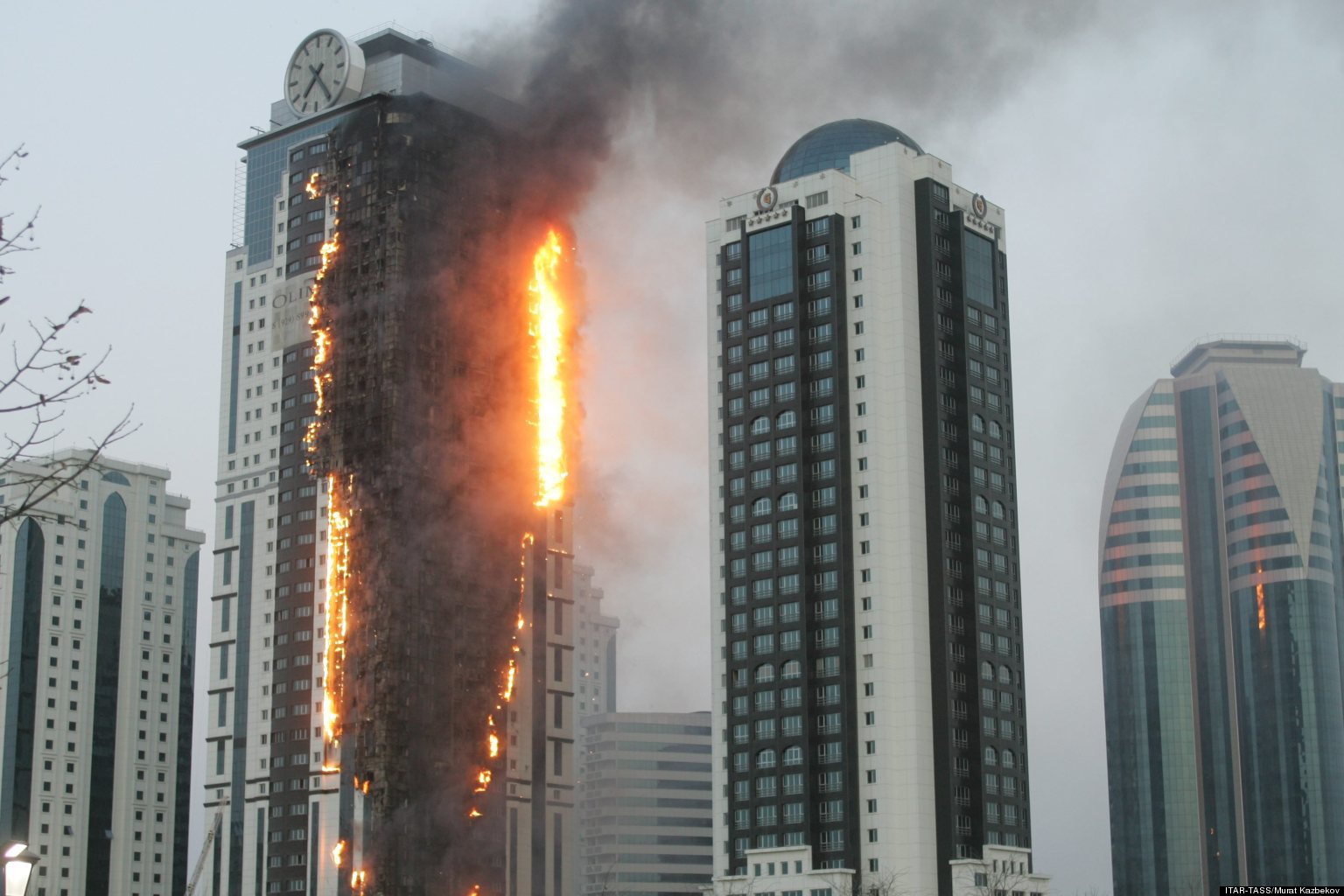
2013 facade fire in Grozny. Photo from huffingtonpost
The research project, named INERSKIN, will develop a toolkit for fire safety optimisation of building façades. With a drive for thermally efficient buildings and sustainability, flammable insulation materials like polymers are more frequently introduced in the design of façades system. Because of the importance of façades and the increasing number of high rise buildings worldwide, it is critical that the interaction of materials and their performance in the event of a fire is understood, modelled and improved. INERSKIN will use artificial intelligence techniques and the state of the art of computational heat transfer to optimize their fire safety.

The student will join the Hazelab, the multidisciplinary research group led by Dr Guillermo Rein and part of the Thermofluids Division in the Department of Mechanical Engineering. The purpose of the group is to reduce the worldwide burden of accidental fires and protect people, their property, and the environment. To do so, Hazelab studies computationally and experimentally heat transfer processes, condensed-phase chemistry and thermodynamics of reactive solids.

You will be an enthusiastic and self-motivated person who meets the academic requirements for enrollment for the PhD degree at Imperial College London. You will have a degree in engineering or physics, and an inquiring and rigorous approach to research together with disciplined work habits. Interests in heat transfer and artificial intelligence are essential. Good team-working and communication skills are essential. Knowledge in fire science and building design are encouraged but not essential prior the project.

Candidates should fulfill the eligibility EPSRC criteria for stipend and fees (UK resident for at least 3 years). Please check your suitability at the following web site: http://www.epsrc.ac.uk/skills/students/help/Pages/eligibility.aspx

For further details of the post, contact Dr Guillermo Rein g.rein@imperial.ac.uk with up-to-date curriculum vitae.

Closing date: 30th April 2016.

Sunday, 3 August 2014

Welcome Nils to Imperial Haze Lab


July was the first month of Nils Roenner at Imperial College London as a new PhD student in m group. He joins the Imperial Haze Lab in the Department of Mechanical Engineering.

Nils is from Germany. He has just graduated with an MEng degree in Mechanical Engineering from Imperial College. In his final year project, he studied numerically the pyrolysis and ignition of polymers subjected to transient irradiation. During his degree, he has also work on a novel device for energy recovery from wood burning stoves. During the summers, he hold internships in several companies, spanning the foundry, mechatronics and electronics sectors.

The preliminary title of his thesis is "Experimental Investigation on the Boosting of Flame Retardancy in Thermoplastics" and is funded by BASF, Germany. The aim of the thesis is to provide a better understanding of the fundamental chemical and heat transfer processes involved in the ignition of thermopastics. In this work, Nils aims at improving the prevention of residential and industrial fires.

Tuesday, 1 April 2014

Welcome Francesco to Imperial Haze Lab

Today was the first day of Francesco Restuccia at Imperial College London as new PhD student in m group. He joins the Imperial Haze Lab in the Department of Mechanical Engineering.

Francesco is from Italy. He became  a Mechanical Engineer from the University of Edinburgh in 2012, and then obtained an MSc degree from California Institute of Technology in 2014. At Caltech, Francesco studied numerically the problem of accidental ignition of liquid fuel tanks. At Edinburgh, he worked on smart distribution networks and renewable energies. He also spend time conducting experiments at CERN Cryogenics.

The preliminary title of his thesis is "Computational Study of Porous Reactive Media" and is funded by EPSRC. The aim of the thesis is to provide a better understanding of fundamental smouldering phenomena to aid in the mitigation and prevention of peat and coal fires. This is frontier research at the interface between combustion science and Earth sciences.

Tuesday, 5 February 2013

Like gravity, wind and quakes: Fire science leads to better infrastructure


While high-rise designers make sure that gravity, winds, quakes and fires do not take their ever complex structures to catastrophic collapse, researchers study structural mechanics, aerodynamics, seismology and fire dynamics so that engineering calculations continuously improve and contribute to safer and safer infrastructure. I had the professional pleasure of being involved in this context first hand, and see some of my fire research work be embodied into real buildings [1].

UPDATE (7/2013): Our research on traveling fires has been highlighted in 'Engineering News-Record' in the article titled "9/11 Blazes Debunk Code Assumptions About FireBehavior in Open-Plan Offices" 


High rises in Madrid. Photo by Oscar Villarejo.

Cast in the PhD theses of Dr Jamie Stern-Gottfried ([2], now at Arup Berlin) and Dr Angus Law ([3], now at Arup Leeds), I led the research team that pioneered the thermodynamics concept of travelling fires for structural engineering. This concept has already impacted on the way industry designs modern infrastructure. Funded by Arup, the work has been applied to a building in the City of London in 2012 even before publication of the latest journal papers [1, 4]. More buildings in London, Cardiff and Manchester have followed. This represents one of the fastest knowledge transfer from research to industry seen in the field.

The idea started when we realized that the current structural design for fire protection is not well suited for 21st Century architecture. Traditional methods for specifying the fire load to the structure assume uniform burning and homogeneous temperature conditions throughout a compartment, regardless of its size. This is in contrast to the observation that accidental fires in large, open-plan compartments tend to travel across floor plates, burning over a limited area at any one time and do not burn simultaneously throughout the whole enclosure. These fires have been labelled travelling fires [1, 4]. Despite these observations, traditional structural fire design methods do not account for this type of fire. Traditional methods are only valid for small enclosures, like those typical of older architecture (eg, apartment blocks vs. modern office space or modern airport lounges).

We used travelling fires to produce more realistic fire scenarios in large, open-plan compartments than the conventional methods. This has been published widely [1-6]. The methodology that we developed is purposely simple but based on actual fire physics. It is also posed in a manner that is compatible to the way structural engineers prefer to think about fire loads and design. It considers a family of fires that includes the full range of physically possible fire sizes, from very small to very large. Traditional methods consider only one fire, two at most, and always of the largest size possible. Small fires spread slowly, large fires spread fast, and fires that occupy the whole compartment area do not spread, they simply burn in place. With this framework in mind, we then split the thermal environment into two regions: the near field (the flames) and the far field (smoke away from the flames). Both fields move along the compartment as the fire spreads. See Figure 2.

Fig. 2. (a) Illustration of a travelling fire and (b) Near field and far field exposure durations at an arbitrary point within the fire compartment. From [1].
Small fires travel across a floor plate for long periods of time (slow spread) with relatively cool far field temperatures, while large fires have hotter far field temperatures but burn for shorter durations (faster spread).

Heat transfer calculations show how much the concrete and the steel members heat up due to different fires. As structural members heat up, they lose strength and induce deformations thus posing a collapse hazard to the building. The higher the temperature the larger the hazard. We found that travelling fires lead to the highest temperatures and have a larger impact on the performance of both concrete and steel structures. They are the most onerous fire scenario to the stability of the building. Thus, in the course of this research, we learnt that conventional design approaches cannot be assumed to be conservative. The results indicate that the worst case scenario would be a medium sized travelling fire between 10% and 25% of the floor area. See Figure 3.

Fig. 3. (a) Gas phase and concrete temperatures for rebar depths of 20, 30, 42 and 50 mm and (b) Peak bay temperature vs. fire area and rebar depth. From [1].

The work [1 to 6] represents the foundation for using this concept for structural analysis and design. The results show that the impact of travelling fires is critical for understanding true structural response to fire in modern, open-plan buildings. See Figure 4. We recommend that travelling fires be considered widely for structural design and the structural mechanics. The four recent buildings mentioned above are the very first structures designed purposely to withstand the thermal load of a travelling fire.

Fig. 4. Comparison of concrete temperatures calculated using the travelling fires (base case) and three traditional methods (standard fire curve, and two Eurocode curves).

The work is continued as part of the EPSRC project "Real Fires for the Safe Design of Tall Buildings" [7] led by Prof Torero and which counts with substantial support from industry (AXA, Arup, BRE, BuroHappold, FM Global, SOM). This project aims to produce data on large-scale fire behavior and remove the main barrier to progress in travelling fires; (as noted in [1]) "incorporating travelling fires into design is challenged by the lack of large scale test data".

Note: One of the first journal papers we published on the topic [5] received the 2011 Lloyd’s Science of Risk Prize in Technology. You can read this past article in the blog here.

References:
  1. J Stern-Gottfried, G Rein, 2011, Travelling Fires for Structural Design. Part II: Design Methodology, Fire Safety Journal 54, pp. 96–112, 2012.
  2. J Stern-Gottfried, 2012, Travelling fires in building design, PhD thesis, University of Edinburgh. 
  3. A Law, 2010, The Assessment and Response of Concrete Structures Subject to Fire, PhD thesis, University of Edinburgh.
  4. J Stern-Gottfried, G Rein, 2012, Travelling Fires for Structural Design. Part I: Literature Review, Fire Safety Journal 54, pp. 74–85, 2012.
  5. A Law, M Gillie, J Stern-Gottfried, G Rein,2011,The Influence of Travelling Fires on a Concrete Frame, Engineering Structures 33, pp. 1635–1642 (open access).  (Winner of 2011 Lloyd's Science of Risk Prize in Technology).
  6. G Rein, 2012, Introduction to Fire Dynamics for Structural Engineers, Training School for Young Researchers COST TU0904, Malta.
  7. EPSRC-funded project, Real Fires for the Safe Design of Tall Buildings.

Friday, 24 August 2012

Two new doctors in fire science

I am delighted to announce that my two PhD students Freddy Jervis and Nicolas Bal have recently defended their theses successfully and are now Doctors of Philosophy in Engineering from the University of Edinburgh. Congratulations. See below the announcements circulated.  

Dr Bal. Email sent by Dr Welch on 21/08/2012 -----
Dear all,
It is my pleasure to inform you that Nico Bal has successfully defended his PhD thesis in the viva exam today, subject to minor editorial corrections. His studies were sponsored by the BRE Trust and supervised by Guillermo Rein, the thesis title was:

"Uncertainty and complexity in pyrolysis modelling"

The external examiner was Chris Lautenberger, Principal Engineer, Reax Engineering (Berkeley, USA); Tim Stratford chaired the exam committee and I was again the internal (fourth time for Guillermo's students!).
By the end of the viva Nico had filled the white board with equations and graphs and we were in no doubt that there is a lot of both uncertainty and complexity in pyrolysis modelling. But out of this complexity Nico has established significant new insights, a great achievement and a platform for lots more interesting work in the field.
Many congratulations to Nico!
Stephen ---


Dr Jervis. Email sent by Dr Welch on 02/07/2012 -----
Dear all,
It is my pleasure to inform you that Freddy Jervis has successfully defended his PhD thesis in the viva exam today, subject to minor editorial corrections. His studies were supervised by Guillermo Rein and the thesis title was:

"Application of fire calorimetry to understand factors affecting flammability of cellulosic material: Pine needles, tree leaves and chipboard"

The external examiner was Prof. Xavier Viegas, forest fires expert from Coimbra University (Portugal)*; I was the internal.
Freddy did an amazing job investigating the intricacies of pine needles combustion using the Fire Propagation Apparatus, with extension to assessment of the effects of leaf morphology on flammability (which has implications for historical changes in fire activity arising from climate-driven floral changes!). At the other extreme his study also looked at the impacts of oxygen and heat flux on burning of chipboard, of relevance to fires in buildings.
Well done Freddy!
 Stephen ---