Showing posts with label geoscience. Show all posts

Friday, 18 November 2016

Fire is a bad master: acceptance speech of the IAWF Early Career Award

16th of November, Long Beach, California, 2nd International Smoke Symposium,
International Association of Wildland Fire (IAWF).

by Dr Guillermo Rein, Imperial College London.


Guillermo (left) receives the award from Dr Tom Zimmerman,
the President of the
International Association of Wildland Fire (IAWF).

I am honoured for receiving the Early Career Award and I am thankful to the Board of Directors and the IAWF for having chosen me. I also would like to thank my students, collaborators, sponsors and my family; if I did something of merit, it was because of their abundant support all the way.

Our mission, the mission of all of us attending the conference, is dual. First to understand fire, and then apply this knowledge to protect the habitants of Earth; namely humans, and Nature itself.

You see. I am an engineer, and my other affiliation is with fire safety in buildings where all fires are unwanted. It is easier: all fire is evil; it must be suppressed and not be given any change to come back to the building.

But fire in the forest can be a force for the good and only becomes evil when unbalance. Indeed, wildfires are important elements of Nature. Not only fire contributes since millions of years ago in shaping most ecosystems on Earth, but fire plays essential roles supporting life through the regulation of atmospheric oxygen, the carbon cycle, and the climate.

This obligatory balance between excess and absence must be attained through the management of fire, and makes the wildfire problem more complex, more important and more fascinating to solve.

Fire science requires more decades of fruitful work and international collaborations to mature and establish a complete understanding of the phenomena and its management. And I am delighted to see the IAWF is at the fore front of these efforts at an international scale, and has become the home where practitioners and researchers come together to talk and share.

I would like to finish with the old Finnish saying:
“Fire is a good servant but a bad master”.


Thursday, 3 December 2015

Tackling the haze in South-East Asia: a call to COP21 Paris

Reprint of my original article published first in the blog of The Grantham Institute.

Peat fires are raging in Indonesia and their extent is staggering. The dry season is not over and NASA satellites have already counted more than 12,000 active fires, which have emitted in excess of 1.6 Gton of carbon dioxide equivalent. This is more than Japan’s annual emissions and close to the footprint of the whole of India. In fact, if peat fire emissions were considered, Indonesia would be the 4th highest emitting country in the world. With COP21 climate negotiations on carbon emissions due to start in just over a week, this widespread haze is choking the population and fauna.

Driven by energy goals and climate change, international efforts are moving towards reducing anthropogenic greenhouse gas emissions and limiting the burning of fossil fuels. However, by ignoring smouldering fires, a major source of greenhouse gases is being overlooked.

The long slow burn

Smouldering fire is a natural phenomenon that burns Earth’s organic-rich deposits, primarily peatlands, soils and coal. Sometimes termed smouldering megafires, these are the largest and longest burning fires on Earth and take place not only in Indonesia, but also in Siberia, Alaska, Florida and Australia to name a few.

Peat megafires destroy essential peatland ecosystems, and release huge quantities of carbon dioxide, carbon monoxide and methane, making up 15% of annual global greenhouse gas emissions. This is the same amount attributed to the whole of the European Union, or all the vehicles worldwide – and yet it is not accounted for in global carbon budgets.

Moreover, the burning of deep peat affects older soil carbon that has not been part of the active carbon cycle for centuries to millennia, and thus creates a positive feedback to the climate system (see Figure 1).
Figure 1. The peat fire problem at the Earth scale, including climate feedback. By G Rein, CC BY 3.0 license

Why so large?

Smouldering combustion is the slow, low temperature, flameless burning of porous fuels. It is sustained by the heat released when oxygen directly oxidises the carbon on the surface of organic soil particles. Once ignited, subsurface organic layers such as those in peatlands or carbon-rich soils burn slowly for long periods of time, spreading deep into the ground and over extensive areas.

Possible ignition events can be natural (e.g. lightning, self-heating, volcanic eruption) or anthropogenic (land management, accidental ignition, arson). Smouldering fires can be initiated by weak sources of ignition and are typically the most difficult to extinguish. Smouldering suppression requires much larger amounts of water than extinguishing flaming fires (it requires actual flooding of the land).

Easy ignition and difficult suppression make smouldering fire the most persistent type of combustion phenomenon on Earth. These fires burn for very long periods of time, lasting months, years, or even decades, despite extensive rains, weather changes and fire-fighting attempts. Peat fires have been active in Indonesia this season for the last more six months or more. They have become endemic in some areas of the world.


Figure 2. Visual and overlaid infrared imaging of radial smouldering spread over a sample of peat ignited at the centre. Photo by Rackauskaite, Huang and Rein (CC BY 3.0 license) http://blogs.egu.eu/divisions/sss/2014/10/01/soils-at-imaggeo-fire-watch-constellation


The Triple Challenge

Given the scale of the problem, relatively little action is being taken. I have identified three major challenges hampering global action:

Challenge #1 – Scientific understanding is poor: There are still large gaps in our knowledge of how smouldering fires ignite, spread or extinguish, which impedes the development of any successful mitigation strategy. Poor scientific knowledge on smouldering even leads to fatal misunderstandings and confusion between flaming and smouldering combustion.

Challenge #2 – Non-existent mitigation technologies: Smouldering megafires are routinely fought across the globe with techniques that were developed for flaming fires. These techniques are ineffective for smouldering fires because the heat transfer and the chemistry involved are completely different. For instance, aerial tankers do nothing to stop smouldering fires because flooding is required instead, and satellite monitoring substantially underestimates the size of peat fires because smouldering can spread underground.

Challenge #3- Topic fragmented among scientific disciplines: Smouldering megafires are an intrinsically multidisciplinary theme requiring collaboration by combustion scientists, ecologists, atmosphere scientists and biochemists.

These three challenges must be overcome before effective mitigation strategies can be implemented. While the largest fires on Earth continue releasing naturally stored carbon into the atmosphere, we are failing to protect both people and the planet.

A Call to Paris

We can reduce the worldwide burden of smouldering megafires and create new technology drivers by pursuing greater experimental understanding and up-scaling our research in the field.

Science is an essential enabler of understanding of peat fires. By strengthening the importance of fundamental knowledge and by consolidating the disciplines interested in the phenomenon, I believe combustion science will serve as the basis for tackling wildfires.

COP21 in Paris has the chance to mobilise the resources needed to advance the science that can lead the way and pioneer technologies against this Earth-scale but unconventional source of emissions.

Further Reading

Monday, 3 August 2015

Breakthrough in the understanding of flaming wildfires

I wrote a commentary article in the Proceedings of the US National Academy of Sciences (PNAS) about a recent stellar contribution to our understanding of how wildfires spread. In doing so, I have written in short the scientific context of wildland fires and also I put forward the possible impacts of the work on the field..
It can be read here ((10.1073/pnas.1512432112), and an except follows.

Breakthrough in the understanding of flaming wildfires

The rise of humanity was intimately bounded to fire. Humans first observed flames when fleeing wildland fires, the natural version of the phenomenon that would then become the most important technological achievement of the human race: the mastery of fire for cooking, lighting, settlement, hunting, and warfare (Bird 1995).
Wildfires are important to the natural sciences. Since deep time, the top surface of the Earth’s crust has been the interface where abundant plant organic matter meets an atmosphere rich in oxygen. This interface is flammable, especially in dry, windy and hot conditions, and leads to wildfire after an ignition event. Not only has fire contributed to shaping most ecosystems on Earth, but it plays essential roles supporting life through the regulation of atmospheric oxygen, the carbon cycle, and the climate (Bowmand et al. 2009, Watson et al. 1978).
As part of the current anthropogenic age, humans have also modified the fire regimes of many ecosystems, and have contributed for example to its cessation in certain regions (e.g., in the USA National Parks until 1960), or to increasing its frequency and severity through drainage (e.g., peatlands) and possibly through climate change (e.g., arctic fires). Of note, multiple US$ billions are spent annually across the world to fight wildfires for the protection of communities and valuable ecosystems.
Despite its central importance to the planet and to humanity, our understanding of fire remains very limited. For example, we currently cannot accurately forecast the location of a fire in 30 min time. To quote Hottel (1984): “A case can be made for fire being, next to the life processes, the most complex of phenomena to understand”. It comes as no surprise, then, that the discipline of fire science is less mature than other Earth science topics. For example, a quick look at the literature shows that there are three times more scientific studies published per year on volcanoes than on wildfires. Fire science requires more decades of fruitful research to mature and gain full understanding of this natural phenomenon.

Rate of Spread


The fate of a flaming wildfire starts with its genesis at ignition, by natural means like a lightning strike, or by anthropogenic means like slash-and-burn. Once ignited, part of the heat released by the flames will drive the spread over connected fuel beds of grass, shrubs, and trees. Another mechanism of propagation is by lofting burning embers that land farther away, but flame spread is more important. The dynamics of spread are such that wildfires accelerate with tail winds, dry weather, or up-slopes; and decelerate with head winds, rain or down-slopes.
The most lasting contribution to the science of wildland fires is the pioneering work of Rothermel in 1972 (Rothermel, 1972). He formulated an empirical model for predicting the spread rate of a wildfire. This formulation is ubiquitous and can be found at the core of most wildfire behaviour simulations. These simulations are currently in use by forestry agencies and firefighting command centres across the world. For example, Rothermel’s model is part of the US Wildland Fire Decision Support System, used in planning of every large and long duration federal wildland fire incident. However, Rothermel’s formulation is empirical: Whilst it can provide rough predictions of the rate of spread by calibration to previous laboratory data, it does not explain how fire spreads. Its empirical nature hinders scientific progress and does not allow for improvements to simulations. Until very recently, there was no valid scientific theory of wildfire spread that could complete Rothermel’s model.
Sketch of flame spread of a fire with tail wind over a fuel bed of fine particles. The paths for heat transfer by
radiation, convection, and flame contact are noted. According to Finney et al. (2015), the vortices are created by buoyant
instabilities and lead to ignition of the fuel by flame contact. Modified from Rothermel, 1972.

Finney et al. 2015


In this context, we see that the recent work of Finney et al. (2015) is a scientific breakthrough. Finney et al. have discovered the long-missing piece of the puzzle to understand wildfire dynamics. Their seminal work puts forward for the first time a fundamental, comprehensive and verifiable theory of flaming wildfire spread. Finney’s theory relates the rate of spread to basic fluid mechanics and heat transfer, and it is strongly supported by laboratory data and field observations across a wide range of scales from 10 cm to 15 m.

Let me put this in the framework of a simple theory. Fire dynamics dictate that spread can be seen as the succession of ignition events (Emmons 1963). This way, the rate of spread s of a fire is given in Eq. (1) by two terms, the length of fuel bed heated by the flames (expressed as δ) and the time that a fuel particle takes to ignite (expressed as tig) (Drysdale 2011).

 s=δ/tig   (Equation 1)

We know that mostly depends on flame inclination and the slope of the terrain, whereas depends mostly on fuel properties like particle size, moisture and plant composition. The scientific contributions of Finney et al. are cast around the novel identification of the two terms in Eq. 1 that govern wildfires.
First, by careful inspection of visual images of fire across scales, they show that vortex flows and peaks-and-troughs generated by the buoyancy of the flames are responsible for heating the fuel bed length δ. Then, temperature measurements then show that the intermittency of the peaks-and-troughs causes the flames to instantaneously touch the thin fuel particles, which in turn produces the contact ignition governing  tig. Figure 1 shows a sketch including these mechanisms.

Convection vs. Radiation


Their work feeds into a long-standing debate in the field on whether it is radiation or convection that controls the heat transfer to the fuel bed ahead (see Fig.1). The specific heat transfer mechanism affects the interpretation of experimental observations, and is critical in correctly formulating physically based models (Morvan 2011). Finney et al. settle the debate by identifying with strong evidence that heat transfer is controlled by flame contact, the phenomenon where both radiation and convection heat transfer are combined, but with the distinctiveness that the timing of flame contact is driven by convective flows.

Profound impact in fire science

Finney’s theory can have a profound impact in the field. The impact is four-fold regarding i) previous scientific studies, ii) wildfire simulations, iii) new technologies, and iv) multi-disciplinarity. These are explained in the following.
Previous scientific studies on wildfire spread should be revisited to help put Finney’s theory into a broader context. experimental and computational studies might need to be reinterpreted in the light of
the roles of flame intermittency and flame contact. The state of the art should naturally revisit and replace Rothermel’s model to give way to a new physically based Rothermel–Finney’s model.

Rothermel-Finney’s model would improve simulations of fire behaviour and help them gain in both accuracy and consistency. This in turn would allow the simulations to provide a more reliable layer of information during fire incidents.
The increased accuracy of simulations should eventually allow for high-fidelity forecasting technologies. A technology able to rapidly forecast the movement of a wildfire would lead to a paradigm shift in the response to emergencies, providing the Fire Service with essential information about the ongoing fire (Rios et al 2014).
The topic of wildfires is currently fragmented among the fields of biology, ecology, meteorology, chemistry, and combustion. These fields have a lot to offer one another, but better communication and cooperation are essential to move it forward. It is hoped that by strengthening the importance of fundamental knowledge and by settling long-standing debates, Finney et al. will serve as the basis for developing new multidisciplinary collaborations in the study of wildfires.

Finally, I foresee that after reading their work, many readers might start seeing the peaks-and-troughs reported by Finney et al. in every wildfire, as I already do now. As the English poet John Milton once said, “so easy it seem'd, once found, which yet unfound most would have thought impossible”.

References

  • MA Finney, JD Cohen, JM Forthofer, SS McAllister, MJ Gollner, DJ Gorham, K Saito, NK Akafuah, BA Adam, JD English (2015) The role of buoyant flame dynamics in wildfire spread. Proc. Natl. Acad. Sci. USA, 10.1073/pnas.1504498112.
  • MI Bird, Fire, prehistoric humanity, and the environment, Interdisciplinary Science Reviews 20(2), 141-154, 1995. DOI:10.1179/isr.1995.20.2.141A.
  • DMJS Bowman, JK Balch, P Artaxo, WJ Bond, JM Carlson, MA Cochrane, CM D’Antonio, RS DeFries, JC Doyle, SP Harrison, FH Johnston, JE Keeley, MA Krawchuk, CA Kull, JB Marston, MA Moritz, IC Prentice, CI Roos, AC Scott, TW Swetnam, GR van der Werf, SJ Pyne, Science 324 (5926), 481-484, 2009. DOI:10.1126/science.1163886. 
  • JE Watson, Lovelock, L Margulis, Methanogenesis, fires and the regulation of atmospheric oxygen, Biosystems 10 (4),pp 293-298,1978. 
  • HC Hottel, Stimulation of fire research in the United States after 1940, Combustion Science and Technology 39:1–10, 1984. doi:10.1080/00102208408923781.
  • RC Rothermel, A mathematical model for predicting fire spread in wildland fuels, USDA Forest Service, Intermountain Forest and Range Experiment Station, Ogden, Utah, Research Paper INT-115, 1972. 
  • HW Emmons, Fire in the forest, Fire Research Abstracts and Reviews 5, 163, 1963. 
  • D Drysdale, An introduction to fire dynamics, 3rd edition. John Wiley and Sons Ltd, Chichester, 2012. 
  • D Morvan, Physical Phenomena and Length Scales Governing the Behaviour of Wildfires: A Case for Physical Modelling, Fire Technology 47 (2), pp 437-460, 2011. doi:10.1007/s10694-010-0160-2. 
  • O Rios, W Jahn, G Rein, Forecasting wind-driven wildfires using an inverse modelling approach, Natural Hazards and Earth System Sciences 14, pp. 1491-1503, 2014. doi:10.5194/nhess-14-1491-2014

Monday, 16 June 2014

Nature’s sport and the Burning Mountain

Figure 1. Newspaper excerpt from 1828 announcing an active volcano in Australia.
Thanks to his knowledge in geology and an investigation of the site, Reverend Charles Wilton ended the rumors of an active volcano in Australia (Fig. 1). In 1829, Rev. Wilton visited Mount Wingen in New South Wales, Australia, and pronounced the phenomenon to be unique, "one other example of nature’s sports", a fire that had been burning for a very long time, "far preceding the memory of man". Indeed, wingen is the word for fire in the aboriginal language of the local Wonaruah tribe.


Mount Wingen, 530 m above sea level, is the highest of two contiguous hills in the Upper Hunter Valley. It is located 25 km North of Scone via the New England Highway and approximately 4 hr drive from Sydney. Its official name is the Burning Mountain Nature Reserve, and I had the pleasure of visiting it in early February 2014 (Fig. 2). The visit fulfilled one of my most desired field trips. I was attending the 11th International Symposium on Fire Safety Science in New Zealand, and I could not forgive myself from a quick stop over to see the Burning Mountain.


Figure 2. Entry to the Nature Reserve of The Burning Mountain, including my symposium bag.

The nature's sport that Rev. Wilton was referring to is the smouldering combustion of a coal seam. The Burning Mountain is the best example of this natural phenomenon that slowly burns the underground coal when it becomes exposed to atmospheric air.  Smouldering is the slow, low-temperature, flameless burning that represents the most persistent type of combustion phenomena and leads to the largest and longest burning fires on Earth. This Australian coal seam started to burn more than 6,000 years ago, some scientists think more than 500,000 years ago. At least the British cannot be blame for it.

The fire is burning now about 30 m below ground. At a rate of 1 m per year, the fire has reached the top of the hill (shown in Figure 3). Because of the creeping spread rate, the slow and intense heat has created a landscape clear of any vegetation in an area 50 m around the hill top. The soil shows a beautiful colour palette of white sinter, yellow sulphate, black char and red iron oxide. Where the fire and heat has not reached yet, a healthy green forest of mature and tall trees can be seen on brown soil. Along the former trail of the fire path, the forest grows back slowly, and young and smaller trees can be seen on red soil. Once at the hilltop, it is easy to feel the hot combustion gases and the smell of sulfur released from multiple deep cracks. The site is surrounded by cracks, some are up to 0.5 m wide, which are more visible ahead of the fire than behind it. Further from the active site by about 20 m, the cracks do not emit gases which to me indicates that the airflow direction is into the seam, feeding the fire with vital oxygen.

Figure 3. The fire has now reached the top of the second hill, where the soil is also a multicolor palette of white sinter, yellow sulphate, black char and red iron oxide.
Some of the most interesting observations that the visitor can do are visually inspections of the trail the fire has left in the area as it has spread for centuries. The entry to the walking track is from the New England Highway, about 1km North of the current fire location (Fig 4). As the visitor walks in from the parking lot, the track goes up to the tallest of the two contiguous hills. Near the hill top, the visitor meets the first clear signs of the fire trail, and then the track follows it chronologically. The fire was burning below the hill top circa 1500s (my estimate). One can see a clear change to less dense vegetation, soil of a strong red colour and more large rocks on the ground. Then, the track goes down a few dozen meters to the saddle point between the two hills and then up to the current fire site. This saddle point is close to where the fire was when it was reported first and confused for a volcano in 1828. I think that the lower ground elevation at the saddle point means the distance between the free surface and the burning seam was at a minimum. Hence, I infer than the much increased air supply contributed to the ferocity of the burning and the plume of smoke ought to have been majestic. The depth to the seam might have been short enough that the coal walls could be seen glowing red. Lava they thought?. This would be nothing compared to the faint hot gases released now that the fire is again at a hill top and more than 30 m deep.


Fig 4. Google maps of the reserve showing the approximate track and the current location of the fire at the top of the second hill.

 An interesting observation that I could make during my visit is that after the hilltop, the forward path of the fire, just 20 m away, is on a very steep fall of 100 m down to the bed of a small river. If the coal seam is running just under the river, the fire could reach again massive proportions as in 1828. Or it could be that the coal seam does not continue after the hill top, and that the fire will naturally extinguish itself within my lifetime after more than 6,000 years burning. Either way, what a lucky historical coincidence for me to witness it happening. I will not miss another visit in the next decade.

The Burning Mountain is just one example. Thousands of underground coalmine fires have been identified around the world, especially in China, India and USA. Elusive, unpredictable and costly, coal fires burn indefinitely while there is fuel, choking the life out of a community and the environment while consuming a valuable energy resource. The associated financial costs run into millions of dollars including the loss of coal, closure of coal mines, damage to the environment and fire-fighting efforts. There are other well-documented cases like when in 1962 an abandoned mine pit in Centralia, Pennsylvania, USA was accidentally lit. Many unsuccessful attempts were made to extinguish it, letting the fire continue to burn until today after more than forty years. Geologist estimate that there is fuel for 250 years more of fire.


Recommended reading (and viewing) on smoldering fires:
  • Abbott, W.E., 1918. Mt. Wingen and the Wingen Coal Measures. Angus & Robertson, Sydney. http://trove.nla.gov.au/work/21299713
  • Mayer, W. , 2009, Geological observations by the Reverend Charles P. N. Wilton (1795 -1859) in New South Wales and his views on the relationship between religion and science, Geological Society, London, Special Publications 310, p197-209. http://dx.doi.og/10.1144/SP310.20
  • Smouldering, Wikipedia, http://en.wikipedia.org/wiki/Smouldering
  • Smouldering Fires and Natural Fuels, by Guillermo Rein, Chapter 2 in:
    Fire Phenomena in the Earth System – An Interdisciplinary Approach to Fire Science, pp. 15–34, Wiley and Sons, 2013. http://dx.doi.org/10.1002/9781118529539.ch2
  • Stracher, G.B., Prakash, A. & Sokol, E.V. (eds) (2010) Coal and Peat Fires: A Global Perspective, 1st edn; vol. 1: Coal – Geology and Combustion. Elsevier Science. 
  • Pennsylvania's 50-Year-Old Coal Fire by SciShow. www.youtube.com

Tuesday, 8 April 2014

G3E4O Geoengineering and the Engineers of Gaia

Earthrise seen by the Apollo 8 crew, 1968. Credit: NASA
Blog by Nils Roenner and Guillermo Rein, Department of Mechanical Engineering at Imperial College London.


Because of global concerns on climate change, engineers are called to have a leading role in tackling the problem, and a new discipline is being proposed: Geoengineering (G3E4O(IN)2R).
The realisation that man has an impact on Earth has led to the idea of the Anthropocene which signifies the current geological epoch, ‘the recent age of man’. Humans are being viewed as a factor and intricate part of nature. This is in agreement with Dr Lovelock’s Gaia hypothesis, introduced in 1979, a revolutionary view of the Earth not as a simple accumulation of systems but as one self-regulating system encompassing everything, including life.
Sketch of the Earth as system of systems with interdependencies and feedback lines outlined. Adopted from Rial et al. 2004 (10.1023/B:CLIM.0000037493.89489.3f).
In an article we wrote in 2013, The Engineers of Gaia, by using the concept of Gaia and the Anthropocene as starting points, we argue that the control system view of Earth is a vital part of geoengineering. It is not about one mechanism, it is about the self-regulating system as a whole. But if geoengineering was to apply a forcing too large or at the wrong place, such that positive feedback loops overtake, the results could be drastic and unpredictable. Careful and robust control is required when engineering something as vital as the system Earth, and this argument is often invoked to stop geoengineering proposals. Paraphrasing Prof Henry Petroski, for us, the premise would be that geoengineers welcome all the relevant science they can muster, but cannot wait for complete scientific understanding before acting to save life or create a new planet-saving technology. We also maintain that up until the moment when adequate understanding and models of the system are found only reversible and well controlled geoengineering interventions should be applied on a large scale, in order to prevent uncontrollable feedback being set off or reaching tipping points by accident.

The term geoeneering has only recently gained traction in the public debate, and its definition still varies according to the source. We think this can be defined as the large-scale anthropogenic intervention into the system Earth in order to adjust planetary mass and heat transfer processes, such that global catastrophes can be mitigated. Geoengineering opens up a broad range of measures with which global climate change can be tackled. No geoengineering approach should be viewed as a single solution to all of the problems associated with climate change. Most likely a combination of approaches will yield long term success. 

Our article briefly evaluates four promising applications of geoengineering using a set of criteria by which geoengineering proposals can be evaluated in term of feasibility, effectiveness, safety, geointervention, and costs.  These are summarized here:

Carbon Capture and Storage is a good option for rich countries aiming at reducing its CO2 emissions from power plants. Apart from its high cost, this method is very feasible and effective with low levels of geointervention and risks.

Biomass Burial is a good option for countries that have suitable and extended land. It is a lower cost approach and can be scaled up to have a larger impact. Low cost, feasibility, effectiveness and low levels of geointervention speak in favour despite some risks, like fire, which need to be managed.

Iron Fertilisation of oceans is an option for countries with coastal access. The low cost involved and the proven feasibility make this method appealing. But concerns about low effectiveness, high level of geointervention and high risks question the validity of the approach.

Cool Roofing of Building is a good approach for densely populated areas or countries with high annual level of sunshine. The low cost, risks and level of geointervention of this feasible option are attractive but on the other hand, it has a weak effectiveness and cannot control secondary effects.

Illustration of the strengths and weaknesses of the proposals under study.
It can be said for all geoengineering proposals, that due to our incomplete understanding of all feedback and threshold points in the global system of the Earth, the topic has to be approached with great caution. But its potential in helping to solve the great problem of climate change, make the efforts put into research and experiments worthwhile.


Tuesday, 1 April 2014

Welcome Francesco to Imperial Haze Lab

Today was the first day of Francesco Restuccia at Imperial College London as new PhD student in m group. He joins the Imperial Haze Lab in the Department of Mechanical Engineering.

Francesco is from Italy. He became  a Mechanical Engineer from the University of Edinburgh in 2012, and then obtained an MSc degree from California Institute of Technology in 2014. At Caltech, Francesco studied numerically the problem of accidental ignition of liquid fuel tanks. At Edinburgh, he worked on smart distribution networks and renewable energies. He also spend time conducting experiments at CERN Cryogenics.

The preliminary title of his thesis is "Computational Study of Porous Reactive Media" and is funded by EPSRC. The aim of the thesis is to provide a better understanding of fundamental smouldering phenomena to aid in the mitigation and prevention of peat and coal fires. This is frontier research at the interface between combustion science and Earth sciences.

Thursday, 22 August 2013

Distinguished award for peat fire paper


I am delighted to announce that our peat fire paper has received the 2013 Distinguished Paper Award on Fire Research at the 34th International Symposium on Combustion. This research award is given biannually by the Combustion Institute.

The work studies the chemistry of smouldering combustion of peat. Peat fires, like those causing haze episodes in South East Asia, are the largest fires on Earth but a poorly understood, yet extensive source of greenhouse gases, and are emerging as a hot topic in climate-change mitigation. These novel combustion experiments provide the framework to study smouldering dynamics by carefully varying the controlling mechanisms and providing burning conditions that otherwise cannot be obtained.This multidisciplinary paper merges the fields of combustion and geoscience, and serves as an example of mechanical engineering contributing to understand Earth-science disciplines like ecology, biodiversity, and biogeochemistry.

Tuesday, 2 July 2013

Keynote: When the soil burns to ash, and smouldering episodes of haze


I gave this morning the first keynote lecture at the 4th International Meeting of Fire Effects on Soil Properties, in the pretty and small city of Vilnius. The title was "Fate of Organic Matter and Pyrogenic Char in Smouldering Fires: when soils burn to ash". I have posted a copy of my slides below.

I started by making a direct reference to the ongoing haze episode in South East Asia, caused by smouldering peat megafires. Like most organic soils, peat is flammable, and dry peat is extremely flammable. This haze episode is expected to last one or two more months, and is leading to a respiratory health crisis and hundreds of millions in economic losses in the region. I then did a quick overview of some smouldering fires as a way of illustrating different fire phenomena  (1997 Indonesia, 2006 Scotland, 2008 North Carolina). After an overview of what smouldering combustion is, I then made a case for these fires to be considered the largest on Earth (the most persistent and longest leading to the highest consumption of fuel). I  reviewed the chemistry of peat fires and some of the laboratory work we have conducted to study their horizontal and vertical spread, and the role of moisture content. The last bit is collaboration with soil chemists on the signature left by smouldering fire for paleoenviromental reconstructions of peat core. I concluded with my global views; that smouldering poses a possitive feedback loop for climate change in the Earth system, and that there is a acute need for more research on the topic.


The lecture was well received with plenty of good questions during the session and the coffee break. In particular I got this question from an American scientists of what would be the best conditions for the production of charcoal/char; it really inspired me and gave me an idea for an experimental and modelling research paper: what is the heat pulse (peak and duration) that leads to the largest production of i) charcoal and ii) char. My guess is that charcoal is maximized by a strong but short pulse (akin to a quick flaming front) whereas char is maximized by the quenching of a propagating smouldering front. 


NOTE: The difference between charcoal and char is that the former, we call it alpha-char, is produced at lower temperatures such that the shape of the original biomass can be identified, and the former, we call it beta-char, is produced at higher temperatures and the shape of the original biomass cannot be identified.

Thursday, 6 September 2012

Chemistry of peat fires

Proceedings of the Combustion Institute
NOTE: This paper received the Distinguished Paper Award on Fire Research at the 34th International Symposium on Combustion by The Combustion Institute.


We have just published a paper in the Proceedings of the Combustion Institute on the chemistry of smouldering peat:

 "Study of the competing chemical reactions in the initiation and spread of smouldering combustion in peat" http://dx.doi.org/10.1016/j.proci.2012.05.060

Smouldering is the slow, low-temperature, flameless burning that represent the most persistent type of combustion phenomena and which leads to the largest and longest burning fires on Earth. Smouldering megafires in peat and coal deposits occur with some frequency during the dry season or eventual droughts in, for example, North America, Siberia, the British Isles, the subartic and South-East Asia.

In this work, we use an experimental methodology to study the smouldering combustion of samples of peat under a wide range burning conditions. By varying the oxygen concentration and the ignition conditions we investigate the competing pyrolysis and oxidation reactions.

We focused on the three main solid species involved in smouldering fires: peat, char and ash . It shows clearly how pyrolysis concentrates carbon in the char while a large fraction of the hydrogen is released, while the oxidation releases most of the carbon and concentrated the minerals in the ash which H, C and N contents are negligible. The fraction of carbon in char is ~1.5 times higher than in peat, and ~35 times higher than in ash. The change is even greater in terms of carbon density, it increases from 77 kg-C/m^3 in the peat to 133 kg-C/m^3 in the char, to then sharply drop to 0.7 kg-C/m^3 in ash.

The experiments clearly show that there are pyrolysis and oxidation reactions. Char is formed by pyrolysis and consumed by oxidation. So at the beginning of a test there is no char, and at the end only a small amount of char remains, but in between substantial amounts of char (~50% of initial weight) were momentarily formed. Smouldering produces and consumes its own char: it initially produces char through pyrolysis before being consumed by char oxidation reactions. The competing nature of the production and consumption char reactions has been experimentally shown (see figure below).

 Evolution of peat and char fractions through an experiment.

The virgin peat reacts during the first 15 min to produce char and ash. Thereafter, only char reactions take place producing ash. Tracking the amounts of peat and char at any given time shows that first char is formed. It reaches a maximum fraction (~50% of the initial mass) in 20 min and then slowly the char is consumed down to ash (10% mass). At the end of the experiment, 90% of the initial mass has been released as gases, leaving a void and a thin layer of ash.

By varying the oxygen concentration and the thermal conditions we investigate the competing pyrolysis and oxidation reactions at a fundamental combustion level. The figure below shows infrared images of the surface of samples at different oxygen levels (21% is normal air) during the early burning stages of ignition (5 min after first heat exposure). As the oxygen level is increased, the temperature of the sample surface increases (indicated by brighter colour) showing that although pyrolysis dominates in this early stages of spread, oxidation reactions also play a role.

 Infrared images of the sample at [O2] of 17%, 21%, 25% and 35%just 5 min after first heat exposure.


The results presented here can be used to advance our fundamental knowledge of large-scale smouldering wildfires which are currently not well understood.

 --
Title: "Study of the competing chemical reactions in the initiation and spread of smouldering combustion in peat"
By: Hadden, Rein and Belcher In: Proceedings of the Combustion Institute (in press), 2012. http://dx.doi.org/10.1016/j.proci.2012.05.060

Wednesday, 25 July 2012

Interview on the accidental burning of ancient carbon

I have been interviewed for GeoLog, the blog of the European Geoscience Union (EGU):

Geotalk: Dr Guillermo Rein


It  features my research on smouldering combustion, the largest fires on Earth and the accidental burning of ancient carbon. It is released as the first interview in the new monthly blog column called Geotalk, featuring short interviews with scientists about their research.

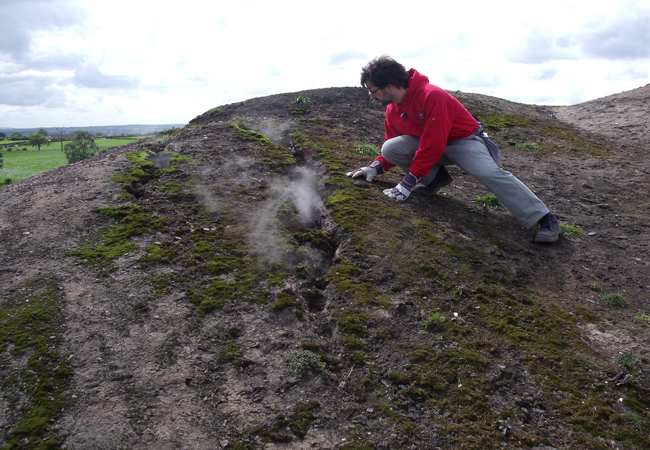
Dr Rein next to a water vapour vent on top of the 30m-high Bogside bing, near Glasgow, Scotland. This bing is a man-made hill of mining waste, and started to smoulder in 2009, approximately 80 years after the closure of the pit. The spread of the combustion is accompanied by the development of vents ahead of the front. (Image by Dr Ricky Carvel and Dr Guillermo Rein, distributed under a CC BY-SA Creative Commons licence)