Showing posts with label smouldering. Show all posts

Friday, 18 November 2016

Fire is a bad master: acceptance speech of the IAWF Early Career Award

16th of November, Long Beach, California, 2nd International Smoke Symposium,
International Association of Wildland Fire (IAWF).

by Dr Guillermo Rein, Imperial College London.


Guillermo (left) receives the award from Dr Tom Zimmerman,
the President of the
International Association of Wildland Fire (IAWF).

I am honoured for receiving the Early Career Award and I am thankful to the Board of Directors and the IAWF for having chosen me. I also would like to thank my students, collaborators, sponsors and my family; if I did something of merit, it was because of their abundant support all the way.

Our mission, the mission of all of us attending the conference, is dual. First to understand fire, and then apply this knowledge to protect the habitants of Earth; namely humans, and Nature itself.

You see. I am an engineer, and my other affiliation is with fire safety in buildings where all fires are unwanted. It is easier: all fire is evil; it must be suppressed and not be given any change to come back to the building.

But fire in the forest can be a force for the good and only becomes evil when unbalance. Indeed, wildfires are important elements of Nature. Not only fire contributes since millions of years ago in shaping most ecosystems on Earth, but fire plays essential roles supporting life through the regulation of atmospheric oxygen, the carbon cycle, and the climate.

This obligatory balance between excess and absence must be attained through the management of fire, and makes the wildfire problem more complex, more important and more fascinating to solve.

Fire science requires more decades of fruitful work and international collaborations to mature and establish a complete understanding of the phenomena and its management. And I am delighted to see the IAWF is at the fore front of these efforts at an international scale, and has become the home where practitioners and researchers come together to talk and share.

I would like to finish with the old Finnish saying:
Fire is a good servant but a bad master”.


Thursday, 3 December 2015

Tackling the haze in South-East Asia: a call to COP21 Paris

Reprint of my original article published first in the blog of The Grantham Institute.

Peat fires are raging in Indonesia and their extent is staggering. The dry season is not over and NASA satellites have already counted more than 12,000 active fires, which have emitted in excess of 1.6 Gton of carbon dioxide equivalent. This is more than Japan’s annual emissions and close to the footprint of the whole of India. In fact, if peat fire emissions were considered, Indonesia would be the 4th highest emitting country in the world. With COP21 climate negotiations on carbon emissions due to start in just over a week, this widespread haze is choking the population and fauna.

Driven by energy goals and climate change, international efforts are moving towards reducing anthropogenic greenhouse gas emissions and limiting the burning of fossil fuels. However, by ignoring smouldering fires, a major source of greenhouse gases is being overlooked.

The long slow burn

Smouldering fire is a natural phenomenon that burns Earth’s organic-rich deposits, primarily peatlands, soils and coal. Sometimes termed smouldering megafires, these are the largest and longest burning fires on Earth and take place not only in Indonesia, but also in Siberia, Alaska, Florida and Australia to name a few.

Peat megafires destroy essential peatland ecosystems, and release huge quantities of carbon dioxide, carbon monoxide and methane, making up 15% of annual global greenhouse gas emissions. This is the same amount attributed to the whole of the European Union, or all the vehicles worldwide – and yet it is not accounted for in global carbon budgets.

Moreover, the burning of deep peat affects older soil carbon that has not been part of the active carbon cycle for centuries to millennia, and thus creates a positive feedback to the climate system (see Figure 1).
Figure 1. The peat fire problem at the Earth scale, including climate feedback. By G Rein, CC BY 3.0 license

Why so large?

Smouldering combustion is the slow, low temperature, flameless burning of porous fuels. It is sustained by the heat released when oxygen directly oxidises the carbon on the surface of organic soil particles. Once ignited, subsurface organic layers such as those in peatlands or carbon-rich soils burn slowly for long periods of time, spreading deep into the ground and over extensive areas.

Possible ignition events can be natural (e.g. lightning, self-heating, volcanic eruption) or anthropogenic (land management, accidental ignition, arson). Smouldering fires can be initiated by weak sources of ignition and are typically the most difficult to extinguish. Smouldering suppression requires much larger amounts of water than extinguishing flaming fires (it requires actual flooding of the land).

Easy ignition and difficult suppression make smouldering fire the most persistent type of combustion phenomenon on Earth. These fires burn for very long periods of time, lasting months, years, or even decades, despite extensive rains, weather changes and fire-fighting attempts. Peat fires have been active in Indonesia this season for the last more six months or more. They have become endemic in some areas of the world.


Figure 2. Visual and overlaid infrared imaging of radial smouldering spread over a sample of peat ignited at the centre. Photo by Rackauskaite, Huang and Rein (CC BY 3.0 license) http://blogs.egu.eu/divisions/sss/2014/10/01/soils-at-imaggeo-fire-watch-constellation


The Triple Challenge

Given the scale of the problem, relatively little action is being taken. I have identified three major challenges hampering global action:

Challenge #1 – Scientific understanding is poor: There are still large gaps in our knowledge of how smouldering fires ignite, spread or extinguish, which impedes the development of any successful mitigation strategy. Poor scientific knowledge on smouldering even leads to fatal misunderstandings and confusion between flaming and smouldering combustion.

Challenge #2 – Non-existent mitigation technologies: Smouldering megafires are routinely fought across the globe with techniques that were developed for flaming fires. These techniques are ineffective for smouldering fires because the heat transfer and the chemistry involved are completely different. For instance, aerial tankers do nothing to stop smouldering fires because flooding is required instead, and satellite monitoring substantially underestimates the size of peat fires because smouldering can spread underground.

Challenge #3- Topic fragmented among scientific disciplines: Smouldering megafires are an intrinsically multidisciplinary theme requiring collaboration by combustion scientists, ecologists, atmosphere scientists and biochemists.

These three challenges must be overcome before effective mitigation strategies can be implemented. While the largest fires on Earth continue releasing naturally stored carbon into the atmosphere, we are failing to protect both people and the planet.

A Call to Paris

We can reduce the worldwide burden of smouldering megafires and create new technology drivers by pursuing greater experimental understanding and up-scaling our research in the field.

Science is an essential enabler of understanding of peat fires. By strengthening the importance of fundamental knowledge and by consolidating the disciplines interested in the phenomenon, I believe combustion science will serve as the basis for tackling wildfires.

COP21 in Paris has the chance to mobilise the resources needed to advance the science that can lead the way and pioneer technologies against this Earth-scale but unconventional source of emissions.

Further Reading

Monday, 16 June 2014

Nature’s sport and the Burning Mountain

Figure 1. Newspaper excerpt from 1828 announcing an active volcano in Australia.
Thanks to his knowledge in geology and an investigation of the site, Reverend Charles Wilton ended the rumors of an active volcano in Australia (Fig. 1). In 1829, Rev. Wilton visited Mount Wingen in New South Wales, Australia, and pronounced the phenomenon to be unique, "one other example of nature’s sports", a fire that had been burning for a very long time, "far preceding the memory of man". Indeed, wingen is the word for fire in the aboriginal language of the local Wonaruah tribe.


Mount Wingen, 530 m above sea level, is the highest of two contiguous hills in the Upper Hunter Valley. It is located 25 km North of Scone via the New England Highway and approximately 4 hr drive from Sydney. Its official name is the Burning Mountain Nature Reserve, and I had the pleasure of visiting it in early February 2014 (Fig. 2). The visit fulfilled one of my most desired field trips. I was attending the 11th International Symposium on Fire Safety Science in New Zealand, and I could not forgive myself from a quick stop over to see the Burning Mountain.


Figure 2. Entry to the Nature Reserve of The Burning Mountain, including my symposium bag.

The nature's sport that Rev. Wilton was referring to is the smouldering combustion of a coal seam. The Burning Mountain is the best example of this natural phenomenon that slowly burns the underground coal when it becomes exposed to atmospheric air.  Smouldering is the slow, low-temperature, flameless burning that represents the most persistent type of combustion phenomena and leads to the largest and longest burning fires on Earth. This Australian coal seam started to burn more than 6,000 years ago, some scientists think more than 500,000 years ago. At least the British cannot be blame for it.

The fire is burning now about 30 m below ground. At a rate of 1 m per year, the fire has reached the top of the hill (shown in Figure 3). Because of the creeping spread rate, the slow and intense heat has created a landscape clear of any vegetation in an area 50 m around the hill top. The soil shows a beautiful colour palette of white sinter, yellow sulphate, black char and red iron oxide. Where the fire and heat has not reached yet, a healthy green forest of mature and tall trees can be seen on brown soil. Along the former trail of the fire path, the forest grows back slowly, and young and smaller trees can be seen on red soil. Once at the hilltop, it is easy to feel the hot combustion gases and the smell of sulfur released from multiple deep cracks. The site is surrounded by cracks, some are up to 0.5 m wide, which are more visible ahead of the fire than behind it. Further from the active site by about 20 m, the cracks do not emit gases which to me indicates that the airflow direction is into the seam, feeding the fire with vital oxygen.

Figure 3. The fire has now reached the top of the second hill, where the soil is also a multicolor palette of white sinter, yellow sulphate, black char and red iron oxide.
Some of the most interesting observations that the visitor can do are visually inspections of the trail the fire has left in the area as it has spread for centuries. The entry to the walking track is from the New England Highway, about 1km North of the current fire location (Fig 4). As the visitor walks in from the parking lot, the track goes up to the tallest of the two contiguous hills. Near the hill top, the visitor meets the first clear signs of the fire trail, and then the track follows it chronologically. The fire was burning below the hill top circa 1500s (my estimate). One can see a clear change to less dense vegetation, soil of a strong red colour and more large rocks on the ground. Then, the track goes down a few dozen meters to the saddle point between the two hills and then up to the current fire site. This saddle point is close to where the fire was when it was reported first and confused for a volcano in 1828. I think that the lower ground elevation at the saddle point means the distance between the free surface and the burning seam was at a minimum. Hence, I infer than the much increased air supply contributed to the ferocity of the burning and the plume of smoke ought to have been majestic. The depth to the seam might have been short enough that the coal walls could be seen glowing red. Lava they thought?. This would be nothing compared to the faint hot gases released now that the fire is again at a hill top and more than 30 m deep.


Fig 4. Google maps of the reserve showing the approximate track and the current location of the fire at the top of the second hill.

 An interesting observation that I could make during my visit is that after the hilltop, the forward path of the fire, just 20 m away, is on a very steep fall of 100 m down to the bed of a small river. If the coal seam is running just under the river, the fire could reach again massive proportions as in 1828. Or it could be that the coal seam does not continue after the hill top, and that the fire will naturally extinguish itself within my lifetime after more than 6,000 years burning. Either way, what a lucky historical coincidence for me to witness it happening. I will not miss another visit in the next decade.

The Burning Mountain is just one example. Thousands of underground coalmine fires have been identified around the world, especially in China, India and USA. Elusive, unpredictable and costly, coal fires burn indefinitely while there is fuel, choking the life out of a community and the environment while consuming a valuable energy resource. The associated financial costs run into millions of dollars including the loss of coal, closure of coal mines, damage to the environment and fire-fighting efforts. There are other well-documented cases like when in 1962 an abandoned mine pit in Centralia, Pennsylvania, USA was accidentally lit. Many unsuccessful attempts were made to extinguish it, letting the fire continue to burn until today after more than forty years. Geologist estimate that there is fuel for 250 years more of fire.


Recommended reading (and viewing) on smoldering fires:
  • Abbott, W.E., 1918. Mt. Wingen and the Wingen Coal Measures. Angus & Robertson, Sydney. http://trove.nla.gov.au/work/21299713
  • Mayer, W. , 2009, Geological observations by the Reverend Charles P. N. Wilton (1795 -1859) in New South Wales and his views on the relationship between religion and science, Geological Society, London, Special Publications 310, p197-209. http://dx.doi.og/10.1144/SP310.20
  • Smouldering, Wikipedia, http://en.wikipedia.org/wiki/Smouldering
  • Smouldering Fires and Natural Fuels, by Guillermo Rein, Chapter 2 in:
    Fire Phenomena in the Earth System – An Interdisciplinary Approach to Fire Science, pp. 15–34, Wiley and Sons, 2013. http://dx.doi.org/10.1002/9781118529539.ch2
  • Stracher, G.B., Prakash, A. & Sokol, E.V. (eds) (2010) Coal and Peat Fires: A Global Perspective, 1st edn; vol. 1: Coal – Geology and Combustion. Elsevier Science
  • Pennsylvania's 50-Year-Old Coal Fire by SciShow. www.youtube.com

Tuesday, 1 April 2014

Welcome Francesco to Imperial Haze Lab

Today was the first day of Francesco Restuccia at Imperial College London as new PhD student in m group. He joins the Imperial Haze Lab in the Department of Mechanical Engineering.

Francesco is from Italy. He became  a Mechanical Engineer from the University of Edinburgh in 2012, and then obtained an MSc degree from California Institute of Technology in 2014. At Caltech, Francesco studied numerically the problem of accidental ignition of liquid fuel tanks. At Edinburgh, he worked on smart distribution networks and renewable energies. He also spend time conducting experiments at CERN Cryogenics.

The preliminary title of his thesis is "Computational Study of Porous Reactive Media" and is funded by EPSRC. The aim of the thesis is to provide a better understanding of fundamental smouldering phenomena to aid in the mitigation and prevention of peat and coal fires. This is frontier research at the interface between combustion science and Earth sciences.

Thursday, 22 August 2013

Distinguished award for peat fire paper


I am delighted to announce that our peat fire paper has received the 2013 Distinguished Paper Award on Fire Research at the 34th International Symposium on Combustion. This research award is given biannually by the Combustion Institute.

The work studies the chemistry of smouldering combustion of peat. Peat fires, like those causing haze episodes in South East Asia, are the largest fires on Earth but a poorly understood, yet extensive source of greenhouse gases, and are emerging as a hot topic in climate-change mitigation. These novel combustion experiments provide the framework to study smouldering dynamics by carefully varying the controlling mechanisms and providing burning conditions that otherwise cannot be obtained.This multidisciplinary paper merges the fields of combustion and geoscience, and serves as an example of mechanical engineering contributing to understand Earth-science disciplines like ecology, biodiversity, and biogeochemistry.

Tuesday, 2 July 2013

Keynote: When the soil burns to ash, and smouldering episodes of haze


I gave this morning the first keynote lecture at the 4th International Meeting of Fire Effects on Soil Properties, in the pretty and small city of Vilnius. The title was "Fate of Organic Matter and Pyrogenic Char in Smouldering Fires: when soils burn to ash". I have posted a copy of my slides below.

I started by making a direct reference to the ongoing haze episode in South East Asia, caused by smouldering peat megafires. Like most organic soils, peat is flammable, and dry peat is extremely flammable. This haze episode is expected to last one or two more months, and is leading to a respiratory health crisis and hundreds of millions in economic losses in the region. I then did a quick overview of some smouldering fires as a way of illustrating different fire phenomena  (1997 Indonesia, 2006 Scotland, 2008 North Carolina). After an overview of what smouldering combustion is, I then made a case for these fires to be considered the largest on Earth (the most persistent and longest leading to the highest consumption of fuel). I  reviewed the chemistry of peat fires and some of the laboratory work we have conducted to study their horizontal and vertical spread, and the role of moisture content. The last bit is collaboration with soil chemists on the signature left by smouldering fire for paleoenviromental reconstructions of peat core. I concluded with my global views; that smouldering poses a possitive feedback loop for climate change in the Earth system, and that there is a acute need for more research on the topic.


The lecture was well received with plenty of good questions during the session and the coffee break. In particular I got this question from an American scientists of what would be the best conditions for the production of charcoal/char; it really inspired me and gave me an idea for an experimental and modelling research paper: what is the heat pulse (peak and duration) that leads to the largest production of i) charcoal and ii) char. My guess is that charcoal is maximized by a strong but short pulse (akin to a quick flaming front) whereas char is maximized by the quenching of a propagating smouldering front. 


NOTE: The difference between charcoal and char is that the former, we call it alpha-char, is produced at lower temperatures such that the shape of the original biomass can be identified, and the former, we call it beta-char, is produced at higher temperatures and the shape of the original biomass cannot be identified.

Thursday, 6 September 2012

Chemistry of peat fires

Proceedings of the Combustion Institute
NOTE: This paper received the Distinguished Paper Award on Fire Research at the 34th International Symposium on Combustion by The Combustion Institute.


We have just published a paper in the Proceedings of the Combustion Institute on the chemistry of smouldering peat:

 "Study of the competing chemical reactions in the initiation and spread of smouldering combustion in peat" http://dx.doi.org/10.1016/j.proci.2012.05.060

Smouldering is the slow, low-temperature, flameless burning that represent the most persistent type of combustion phenomena and which leads to the largest and longest burning fires on Earth. Smouldering megafires in peat and coal deposits occur with some frequency during the dry season or eventual droughts in, for example, North America, Siberia, the British Isles, the subartic and South-East Asia.

In this work, we use an experimental methodology to study the smouldering combustion of samples of peat under a wide range burning conditions. By varying the oxygen concentration and the ignition conditions we investigate the competing pyrolysis and oxidation reactions.

We focused on the three main solid species involved in smouldering fires: peat, char and ash . It shows clearly how pyrolysis concentrates carbon in the char while a large fraction of the hydrogen is released, while the oxidation releases most of the carbon and concentrated the minerals in the ash which H, C and N contents are negligible. The fraction of carbon in char is ~1.5 times higher than in peat, and ~35 times higher than in ash. The change is even greater in terms of carbon density, it increases from 77 kg-C/m^3 in the peat to 133 kg-C/m^3 in the char, to then sharply drop to 0.7 kg-C/m^3 in ash.

The experiments clearly show that there are pyrolysis and oxidation reactions. Char is formed by pyrolysis and consumed by oxidation. So at the beginning of a test there is no char, and at the end only a small amount of char remains, but in between substantial amounts of char (~50% of initial weight) were momentarily formed. Smouldering produces and consumes its own char: it initially produces char through pyrolysis before being consumed by char oxidation reactions. The competing nature of the production and consumption char reactions has been experimentally shown (see figure below).

 Evolution of peat and char fractions through an experiment.

The virgin peat reacts during the first 15 min to produce char and ash. Thereafter, only char reactions take place producing ash. Tracking the amounts of peat and char at any given time shows that first char is formed. It reaches a maximum fraction (~50% of the initial mass) in 20 min and then slowly the char is consumed down to ash (10% mass). At the end of the experiment, 90% of the initial mass has been released as gases, leaving a void and a thin layer of ash.

By varying the oxygen concentration and the thermal conditions we investigate the competing pyrolysis and oxidation reactions at a fundamental combustion level. The figure below shows infrared images of the surface of samples at different oxygen levels (21% is normal air) during the early burning stages of ignition (5 min after first heat exposure). As the oxygen level is increased, the temperature of the sample surface increases (indicated by brighter colour) showing that although pyrolysis dominates in this early stages of spread, oxidation reactions also play a role.

 Infrared images of the sample at [O2] of 17%, 21%, 25% and 35%just 5 min after first heat exposure.


The results presented here can be used to advance our fundamental knowledge of large-scale smouldering wildfires which are currently not well understood.

 --
Title: "Study of the competing chemical reactions in the initiation and spread of smouldering combustion in peat"
By: Hadden, Rein and Belcher In: Proceedings of the Combustion Institute (in press), 2012. http://dx.doi.org/10.1016/j.proci.2012.05.060

Wednesday, 25 July 2012

Interview on the accidental burning of ancient carbon

I have been interviewed for GeoLog, the blog of the European Geoscience Union (EGU):

Geotalk: Dr Guillermo Rein


It  features my research on smouldering combustion, the largest fires on Earth and the accidental burning of ancient carbon. It is released as the first interview in the new monthly blog column called Geotalk, featuring short interviews with scientists about their research.

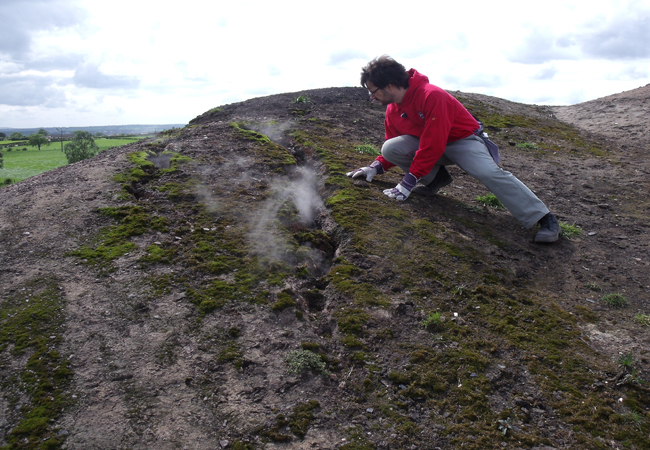
Dr Rein next to a water vapour vent on top of the 30m-high Bogside bing, near Glasgow, Scotland. This bing is a man-made hill of mining waste, and started to smoulder in 2009, approximately 80 years after the closure of the pit. The spread of the combustion is accompanied by the development of vents ahead of the front. (Image by Dr Ricky Carvel and Dr Guillermo Rein, distributed under a CC BY-SA Creative Commons licence)

Monday, 5 March 2012

Biomass self-heating fire in Tilbury Power Plant?

The Tilbury Power Plant (Essex, UK) suffered a large fire on 27 Feb 2012 [BBC]. The blaze involved two fuel storage units and led to the immediate closure of the plant. The blaze was controlled in one day by a crew of about 120 officers from the Fire & Rescue Service. The plant will not be fully functioning again until June. RWE, the owner of the plan, said direct damages have been estimated to cost around €4m. The losses for business interruption would be in addition to this.

July 2012 UPDATE:  Since the end of June, and as planned, two units are back to normal operation at Tilbury. The rest of units are expected to be working in one month time. More importantly, RWE officials have now confirmed to the press that the fire was caused by self-heating of biomass pellets leading to a smouldering fire:  "it is likely that the increased levels of oxygen caused the ignition of the smouldering dust" [Utility Week].

Nov 2012 UPDATE: The largest power station in the UK, Drax, is ready to burn biomass too. They are building four giant domes to store the fuel, about 30 m tall each. I am not familiar with the internal divisions of these domes, but I note that it seems well above the critical self-heating size, specially during summer time. See the domes in this video of the BBC.


Panoramic of Tilbury Power Plant before the fire. Photo from www.rwe.com

 Tilbury Power Plant during the fire (2012). Photo from East News/www.mirror.co.uk
 
Tilbury was a ~1100 MW coal-fired power plant buitl in 1969. Now it is one of the biggest and most environmentally-friendly combustion power plants in the world after having gone a partial reconversion to biomass burning (750 MW, biomass shipped from the US [The Guardian]). The conversion aimed to "prove that sustainable biomass can play a role in long term carbon reduction, it is crucial to test the technology on large-scale" [RWE]. It was just about to star operations of these new facilities when the fire took place.

I look forward the results of the ongoing fire investigation to identify the cause and origin, but I could not avoid jumping into some some early conjetures.

The fire started in the new biomass storage units where fresh loads of biomass had been stored for the first time (~6,000 tons of biomass pellets). This strongly hints to self-heating as the most probable cause. Self-heating refers to the tendency of certain materials, like biomass pellets and coal, to spontaneously heat up and smoulder at ambient temperatures. This can result in a spreading fire without intervention of any external heat source. The topic is one of my fields of expertise. Power companies know well how to avoid self-heating of coal piles (small stockpiles, ventialtion, quick turn overs) but when a new reactive solid is stored (in this case biomass) the problem can go undetected until the accident takes places. This is the price of innovation. Several types of biomass pellets are known to be more reactive at low temperatures than coal. And this would not the first time that the hazard has been underestimated by applying coal self-heating standards to biomass storage.

Unfortunately, all the biomass involved in the fire was burnt and none of the heat could be used for power or human comfort. The associated pollution (CO, VOC, PAH) and CO2 reached the atmoshpere wihtout giving us any of the potential benefits. Thin favour to sustainablility.

Friday, 27 January 2012

Smouldering fire of large compost heap in Havelock

After Hurricane Irene made landfall on Aug 27, 2011, the city of Havelock in North Carolina (USA) decided to shred all damaged trees and vegetation and collect them in a large heap. The resulting biomass stockpile was ~4000 m^3 in volume, the equivalent capacity of a 16 m cube. The idea was to produce plenty of free compost for the city.

But as the heap dried and decomposed, on its way to become compost, it also started to self-heat and a smouldering fire was initiated without any external source. All organic porous media is known to self-heat under the right environmental conditions of low moisture, poor ventilation and large stockpiles, and these were met in the Havelock heap. Havelock News reports that the fire was first detected on Jan 17, 2012, probably becuase of large and visible off-gassing. This means that the first hotspots formed several weeks before that, maybe during early Fall. After it was detected, the Fire Havelock Fire and Rescue Department and the US Forest Service were called in. They dosed large amounts of water and spread the heap material over a wider area to quench the fire. And it worked, so far. But hotspots deep into the heap are going to be very difficult to cool down completely.
A bulldozer spreads out the pile of smouldering biomass in Havelock. Photo by Drew C. Wilson/Havelock News.
Self-heating
In this poster that I presented recently, I explained self-heating as follows:
"Self-heating refers to the tendency of certain reactive solids in oxidative atmospheres to spontaneous exothermic reactions at low or ambient temperatures. This is a well known problem for industries transporting and storing porous carbon-rich materials [eg, peat, biochar, coal, char and most organic powders]. Initially, small amounts of heat are released and accumulate during longer times when heat losses are low (eg, large stockpiles, high ambient temperatures). This results in a sustained increase of temperature without any external heat source. Above a certain temperature, the process self-accelerates and leads to thermal run away. For example, Semenov’s Ignition Theory describes mathematically the process as controlled by heat generation and heat losses"
Mititating Actions
The main culprit in the case of the Havelock heap seems to be its large size. In other to prevent self-heating events, stockpiles must be kept below a certain critical size. The fact that the fire was detected in winter time when ambient temperatures are low (between -1 and 10 C), testifies to the strong reactivity of the biomass heap. But there are other contributing factors. In order to mitigate the risk of self-heating fires, heaps ought to be designed complying with the following principles:  

*Stockpile size: As the size of the pile is made smaller, heat losses increase and the risk of self-heating is reduced. The maximum safe stockpile size is given by the ambient temperature and reactivity of the material.  *Wetting: Material with large moisture contents do not ignite.  
*Ventilation: Add design features that enhance natural ventilation and cooling.
*Inertation: Reduce reactivity by mixing the biomass with inert material like sand (see here).

Where these observed in this case?

Tuesday, 15 November 2011

Smouldering mega-fires in the Earth system

I just gave the presentation "Smouldering mega-fires in the Earth system" at the conference Exploring the Mega-fire Reality, Florida State University. It went well very,  good questions (~8) from audience and great feedback. The abstract is below.

Smouldering mega-fires in the Earth system

Abstract
Smouldering fires, the slow, low-temperature, flameless burning of organic matter release anually at a global scale the equivalent to ~15% of man-made carbon emissions. It accounts for the accidental burning of fossil fuels, including natural as well as antropogenic causes. Very large fires of organic matter (mostly in peatlands) have burnt since past millennia for long periods of time (months, years, decades; the longest continuously fires on Earth). Flaming forest fires have been the central focus of most research, but smouldering mega-fires are paramount to the Earth System and have received very little attention. Smouldering is the most persistent type of combustion phenomena; the easiest to ignite, and the most difficult to suppress. Peat fires propagate slowly (~1 mm/min) through organic layers of the ground and can reach depth >5 m when large cracks or a natural piping system exists. It is a 3-dimensional phenomena, spreading deep into the soil and over extensive areas of land. The depth of burn is given by the location of the inert layer, very moist layer (>125%MC) or firefighting attempts. Observed depths of burn reported in the literature range from 0.1 to 5 m, with the average around 0.5 m (=75 kg/m2 of fuel consumption). This is 40 to 90 times larger than flaming fires. In terms of fuel consumption, these are mega-fires. This is of great concern given that world peatlands contain more terrestrial carbon than the forests or the atmosphere. Compared to the natural carbon flux to the atmospherefrom from peatland degradation, smouldering fires is 3,000 times faster. These wildfires burn fossil fuels and thus are a carbon-positive fire phenomenon via soil moisture deficit and self-heating. Warmer temperatures at high latitudes are resulting in more frequent Artic fires and unprecedented permafrost thaw.


Monday, 24 October 2011

Smouldering and self-sustaining reactions in solids: an experimental approach

I am delighted to announce that the PhD thesis of my student Rory is now online:

Smouldering and self-sustaining reactions in solids: an experimental approach (clik on title for pdf)
by Rory Hadden, PhD, University of Edinburgh, 2011 

The Ostedijk on 21st February (the 5th day) after
the hold was opened and before specialized firefighting activities had
commenced. Derived from photograph courtesy of Agencia EFE.
Abstract: Smouldering combustion governs the burning of many materials in the built and natural environments. Smouldering is flameless, heterogeneous combustion which occurs when oxygen reacts with the surface of a solid fuel. Understanding the conditions which will result in the ignition and smouldering of a porous fuel is important and the phenomena involved are complex and coupled, involving heat and mass transfer, and chemical kinetics. This thesis reports experimental studies of the ignition, spread, suppression and emissions from reactions in porous media. Similar experimental techniques are shown in this thesis to be applicable when studying a wide range of solids which undergo self-sustaining reactions. This thesis is presented in a manuscript style. Each chapter takes the form of an independent paper which has been prepared for journal publication and as such, each chapter can stand on its own as a piece of research. A final chapter summarizes the findings and conclusions and suggests further areas of research.
The evolution of char and peat fractions throughout the
experiment and the mass loss rate. The fraction of peat decreases and
the fraction of char increases from the beginning of the experiment until
around 20 min. During this period, the pyrolysis front is propagating
through the sample, resulting in the formation of char from the thermal
decomposition of peat. After 20 min, the pyrolysis front has propagated
through the sample and the resulting char is undergoing oxidation to
form ash and gaseous products. Error bars represent the average error
from three repeats.


Chapter 1 presents a study of self-sustaining decomposition (SSD) of NPK ammonium-nitrate-containing inorganic fertilizer. Findings were applied to the events that occurred aboard the Ostedijk in 2007.

Chapter 2 is a study of smoulder in polyurethane foam to study the relationship between sample size, critical heat flux and spread rate. This is important becuase smouldering fires are the leading cause of residential fire deaths in developed countries and polyurethane foam is ubiquitous in the modern world.

Chapter 3 presents an experimental investigation into the ignition of porous fuels by hot particles. This is related to the problem of spotting ember ignition in wildland fires which is a major, but poorly understood, spread mechanism. The process of spotting occurs in wildland fires when fire-lofted embers or hot particles land downwind, leading to ignition of new, discrete fires.

Chapter 4 is an investigation into the suppression of smouldering coal. Subsurface coal fires are a significant global problem with fires in China alone estimated to consume up to 200 million tons of coal per year. As global demand for coal increases, accidental fires are a waste of a useful energy resource as well as a source of pollution and greenhouse gases. The results are the first attempt reported in the literature to study the suppression of these fires under controlled laboratory conditions.


The mass flux of CO (red) and CO2 (blue) for experiments
in which flaming was ignited using a pilot flame (solid) and where
only smoulder was observed (dashed). The shaded region represents
the duration of the flaming. The inset details differences in emissions
during the period of flaming.
Chapter 5 presents an experimental investigation of the smouldering behaviour of peat. This is of particular interest in understanding the impact of smouldering fires on the earth system. The longer burn durations and different combustion dynamics of smouldering compared to flaming means that they have been shown to consume large amounts of biomass in, and contribute significantly to the emissions from, natural fires occurring in peatlands. The dynamics of smouldering peat in shallow, strong fronts was studied in the Fire Propagation Apparatus and a smoulder reaction framework with two burning regimes is presented.

Chapter 6 complements Chapter 5 with an analysis of the CO and CO2 emissions for smouldering and flaming peat. This data can be used with large-scale measurement techniques to improve emission estimates. The emissions are found to be dependent of the burning regime and the type of combustion with flaming resulting in higher fluxes of CO2 and lower fluxes of CO compared to peat smouldering. The large majority of emissions (85% of CO2 and 97% of CO) are released during the smoulder phase of the reaction. This highlights the differences in the chemical processes occurring under these two modes of combustion.

Chapter 7 summarizes the research undertaken in this thesis and presents possible further work.

Tuesday, 13 September 2011

Accidental Burning of Fossil Fuels

(aka, Accidental Emissions from Fossil Fuels)
Next week, I will present at the Royal Academy of Engineering a brief poster summarizing the work that I have developed with the generous funding of the RAEng/Leverhulme Fellowship. The poster is here (pdf). A related seminar I gave at UC Berkeley in July can be watched in youtube here (and see at the end of this post). The following reproduces the content of the poster:

World energy use and climate change science have led to concerns on sustainability, man-made burning of fossil fuels, and carbon emissions. Most attention is paid to energy efficiency, clean technologies and new resources. But unintentional and non-anthropogenic sources contributing to the problem have been ignored. Smouldering megafires, the largest and the longest-burning fires on Earth (>6,000 years), take place in all continents except Antarctica, and burn fossil fuels accidentally.

Smouldering of carbonaceous media (flameless combustion) is the most persistent fire phenomenon on Earth. Photo by Jens Buurgaard Nielsen (wikipedia).
Very large smouldering fires of carbonaceous natural media (coal seams and peatlands) have burnt since past millennia for long periods of time (months, years, decades). Peat fires burn during the warm/dry season in Indonesia, Canada, Russia, and USA. Hundreds of coal fires continuously burn in USA, China and India. Globally, the problem has grown to a current carbon release equivalent to 10-30% of man-made emissions, and a coal consumption rate five times faster than that of Germany.

Oct 1997: aerosol imaging by NASA TOMS shows the vast smoke haze released by smouldering peat fires in Indonesia. Photo by NASA.
Smouldering phenomena involve the burning of fossil fuels and are carbon-positive. This creates a positive feedback mechanism in the climate system: Moisture deficit and self-heating of carbonaceous media are enhanced under warmer climates and lead to more frequent smouldering fires. Warmer temperatures at high latitudes are already resulting in large smouldering fires in the Arctic (e.g., Alaska 2010).


Positive feedback by smouldering fires in the climate system (topics I study are represented by red arrows)

Stopping these fires is an engineering task at the Earth-scale. RAEng states that “geoengineering provides options in which the Earth’s climate is deliberately manipulated to offset the effects of global warming due to increasing levels of greenhouse gases”. I am contributing to this through the study of the ignition, spread, emissions, and suppression of smouldering phenomena. I aim to develop both fundamental understanding and technological solutions to this problem.


Accidental Burning of Fossil Fuels (RAEng 2011)