Wednesday, 28 July 2010
Volume 1 of 'Coal and Peat Fires: A Global Perspective'
We are delighted to inform you that Volume 1 of 'Coal and Peat Fires: A Global Perspective' - our four volume book series - will be on the market in October 2010.
Elsevier has hosted a microsite at http://www.elsevierdirect.com/coalpeatfires where you can
- Read more about the book series
- Find the table of content and download a sample chapter from Volume 1
- Learn about how you can contribute to the online archive of coal fires
- Order the book and receive discount for early purchase
- And much more ....
We hope you enjoy the book series and we look forward to your feedback.
Sincerely,
Editors: Glenn Stracher, Anupma Prakash, Ellina V. Sokol
Guest Editors: Rudiger Gens, Guillermo Rein
Sunday, 30 May 2010
Ancient climate change is a burning issue
Millions of years ago in East Greenland, warming climate and high levels of CO2 in the atmosphere caused plants to evolve from having thick to narrow leaves, which helped prevent them from losing water. Laboratory experiments (in the BRE Centre for Fire Safety Engineering) have shown plants of this shape to be more flammable, and therefore prone to wildfires. The study sheds light on how climate-driven changes in vegetation can cause increases in the flammability of plants. This research may help understanding of whether or not plant life could become more flammable based on global warming estimates.
The work, "in a truly innovative test of their hypothesis, used a Fire Propagation Apparatus calorimeter to test the flammability of modern plant analogues to the Triassic and Jurassic vegetation"
A plant sample of Monkey puzzle being tested for fire behaviour in the Flame Propagation Apparatus calorimeter
The joint research between Fire engineers at the University of Edinburgh and Earth scientists at University College Dublin, the University of Oxford and the Field Museum of Natural History in Chicago, was funded by EU Marie Curie and the University of Edinburgh’s BRE Centre for Fire Safety Engineering and published in Nature Geoscience. Their work also made it onto the front cover (see illustration bellow).
"We wanted to test a theory that says if atmospheric CO2 doubles, forest fires in North America may increase by 44 per cent. We tested this by studying how ancient plants and fire changed in the past and used modern experiments on living plants – much like those that grew 200 million years ago – to show that under these conditions, plants became more flammable".
Dr Guillermo Rein, co-author of the work, of the University of Edinburgh’s School of Engineering, said:
"This research brought together scientists from very different backgrounds, and doing so has given us insights into ancient wildfires that we might otherwise not have had. This is the first time our cutting-edge flammability technology has been applied to test geoscience hypothesis and highlights how new ideas can be formed when scientists from very different backgrounds meet".
For more information please contact:
Dr Claire Belcher, belchercm (at) gmail.com and see her website
Monday, 19 April 2010
Artículo en el Anuario El País "Incendio latente bajo las Tablas de Daimiel"
He escrito para el Anuario El país un articulo corto sobre el incendio soterrado de las Tablas de Daimiel. Incluyo el texto abajo. La version en pdf esta aquí.
-- --
Anuario El País 2010, página 138:
Incendio latente bajo las Tablas de Daimiel
por Guillermo Rein Soto-Yarritu
El incendio de las turberas secas del Parque Nacional de Las Tablas de Daimiel que se detectó en el verano de 2009 llevó a la sociedad española a conocer de primera mano y de golpe la amenaza que representan los incendios latentes.
Para la comunidad internacional este descubrimiento fue igual de repentino, pero ocurrió unos años antes. No fue hasta después de los grandes incendios de 1997 en Indonesia cuando la comunidad científica reconoció la amenaza económica y ecológica de los incendios latentes. Estos incendios de turberas secas duraron varios meses y destruyeron en total 790.000 mil hectáreas de bosque tropical. La gran nube de humo que se produjo se extendió sobre tierra y mar, desde el norte de Australia hasta el sur de China. Los servicios de urgencias hospitalarias se colapsaron con casos de enfermedades respiratorias y varias rutas de navegación área se cerraron durante semanas por falta de visibilidad. Los países del sureste asiático se quejaron formalmente del suceso y esto llevó a la firma en 2002 del acuerdo de la Asociación de Naciones del Sureste Asiático (ANSA) sobre contaminación atmosférica transfronteriza. Se ha calculado que el carbono liberado en forma de gases de CO y CO2 durante este incendio fue equivalente a entre el 13% y el 40% de las emisiones globales de carbono de 1997, y contribuyó al mayor aumento en la concentración de CO2 en la atmósfera registrado hasta entonces.
Los incendios latentes también afectan a las turberas en zonas tropicales, templadas y boreales. Hay documentados casos en Canadá, California, Carolina del Sur, Siberia, islas Británicas, islas Malvinas, África meridional, España y muchos otros. Las turberas se forman por la acumulación de materia vegetal muerta durante miles de años que se va descomponiendo. Es como un carbón muy joven. Mundialmente, las turberas son una de las mayores reservas de carbono terrestre, y su contenido es
superior al de los bosques y comparable al de la atmósfera. Hay otros materiales que se pueden quemar de forma latente: carbón, humus, madera, celulosa, algodón, tabaco y varios polímeros. De hecho, el incendio activo más antiguo del mundo afecta a las vetas de carbón en Burning Montain, Australia, que llevan ardiendo de forma latente 6.000 años.
La combustión latente (smouldering, en inglés) es la forma lenta y sin llama que muestran algunos sólidos al quemarse. Se desarrolla por el calor desprendido cuando el oxígeno en la fase gaseosa reacciona con el carbono en la fase sólida. La reacción tiene lugar sobre la superficie del sólido y no en el gas como en una llama. El rango de temperaturas, la velocidad de propagación y el calor liberado son bajos comparados con una flama. El rango de temperaturas típicas que alcanza está entre 500 y 800°C, mientras que una llama alcanza de 900 a 1200°C. Un incendio latente se propaga a una velocidad muy baja, del orden de 1-5 centímetros/hora.
Los incendios latentes crecen y mueren muy lentamente. No tienen prisa. Se pueden iniciar por cuatro causas principales: proximidad de unos incendios forestales de llama en la superficie, impacto de un rayo, calentamiento espontáneo o propagación de un incendio latente a través de la red natural de canales de la turba. En el caso de Las Tablas de Daimiel, se ha hablado varias veces del calentamiento espontáneo (“autocombustión”, se ha dicho erróneamente) como la causa de este episodio, sin resaltar que eso es sólo una hipótesis aún no contrastada suficientemente.
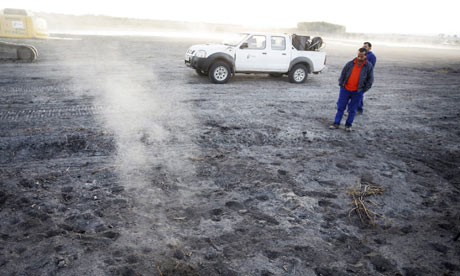
Además, son muy difíciles de detectar y localizar. El núcleo o núcleos del incendio pueden estar varios metros bajo el suelo, liberando el humo a través de la extensa red natural de canales que tiene la turba, pero sin dejar casi rastro en la superficie. El humo ha viajado por esos canales, que pueden ser de cientos de metros de largo, y sale a la atmósfera más frío y diluido con el aire atmosférico. Por eso, visualmente, tan solo se aprecian fumarolas aisladas, aparentemente, y un ligero calentamiento en la salida a la superficie.
La extinción de un incendio latente es una de las pesadillas a las que los bomberos se tienen que enfrentar. A pesar de los múltiples intentos de extinción de incendios soterrados de gran extensión en todo el mundo, hasta la fecha muy pocos casos de intervención humana han tenido éxito confirmado. Sólo la inundación total puede garantizar la extinción de un incendio en turberas de una vez por todas. Un buen ejemplo de extinción por intervención humana tuvo lugar en Carolina del Norte en el verano de 2008, cuando las turberas del parque nacional Pocosin Lakes National Wildlife Refuge prendieron de forma accidental. Más de 450 bomberos trabajaron durante tres meses para inundar la zona y sólo después de la inundación total se pudo dar por extinguido. La inundación funciona porque por encima del 55% de agua en peso, la turba no se puede quemar. Esto es, si el suelo está mojado o encharcado, el fuego latente se extingue. La inundación parcial no es suficiente, pues si quedaran puntos calientes
sin inundar, estos podrían volver a propagarse cuando la turba se seque de nuevo.
En el caso de Las Tablas de Daimiel, la escalada incontrolada del incendio se evitó con las grandes labores de extinción y prevención llevadas acabo a finales del otoño, que redujeron y contuvieron el incendio. Y al final, las turberas del parque se inundaron completamente por la intervención de la madre naturaleza, que envió un invierno muy húmedo para La Mancha, y, en menor medida, por la ayuda del transvase desde el Tajo.
El estado natural de las turberas del Parque de Las Tablas de Daimiel es la inundación. Coincide que este estado natural evita el problema del fuego latente. La pregunta es cuánto tiempo estarán Las Tablas de Daimiel encharcadas.
Tuesday, 16 March 2010
Networks of like-minded researchers effectively excluding newcomers
I never finished reading my copy of The Structure of Scientific Revolutions by Kuhn. Maybe this is a good time to continue the reading and reflect on the role of newcomers in paradigm shifts.
NOTE: Times talks about this here
Sunday, 21 February 2010
When the means deform the objective (video)
Enjoy.
- On the Level: All Bean Maxwell wants is for the picture on his foyer wall to hang level.
Friday, 19 February 2010
Inspiring talk on a global problem related to combustion: cheap, clean-burning, solid fuels
Prof Smith research is based on invent cheap, low-tech devices that use local resources, so communities can reproduce her efforts and ultimately help themselves. That is just worth being imitated indeed.
I quote from their website: TED is nonprofit organization devoted to Ideas Worth Spreading. It started out in 1984 as a conference bringing together people from three worlds: Technology, Entertainment, Design. TED believes passionately in the power of ideas to change attitudes, lives and ultimately, the world.
Wednesday, 27 January 2010
An incomplete view on climate change
The level of investment and prestige put on the scientific disciplines studying climate change has boosted in the last decade. This was to be expected, because they play a key role in a global and important topic that matters to society, industry and governments. Their achievements (tiny or small they might be) must be communicated, celebrated worldwide and commended with prestige, awards and further grants to continue the good work. Consequently, when errors (tiny or small they might be) are found, their professional responsibility must be required in proportion to the prestige, awards and grants gained.
In the same way, climate experts that have received awards, grants and professional prestige should not be surprised to find themselves under proportionally high pressure to review and justify once again their results.
Summary: "For everyone to whom much is given, of him shall much be required" Luke 12:48
I am not an expert in the topic, but I also have some views on it.
As a scientist doing research at the University of Edinburgh on thermal science, I see climate change as a very complex issue, dealing with an immense system, the Earth. The level of uncertainty attached to any prediction on a system this large has to be proportional to its size, immense. All my professional respect goes to climate scientists who are dealing with a very difficult problem to tackle.
As an engineer by training and an consultant to industry, I feel that most core solutions proposed so far to tackle the problem of climate change tend to lead as well towards improvements in energy efficiency, development of new technologies, alternative ways of engineering thinking and would foster the creation of new paradigms. This would be great news indeed. Even if climate change were not to be that 'fast' at the end, some proposed solutions could be good just by itself.
And as a citizen of the world, I worry that lobbies of many different colours and aims claim to understand well enough the complex scientific concepts behind climate change and dare to produce crystal-clear conclusions that might not be taking into account all the uncertainties.
Not an easy topic indeed, but worth our attention and effort, and also the pains that come from the heated debate.
NOTE: I write this on the train to London. Great views today of the English country side!
Monday, 11 January 2010
in the NYTimes!
Spain Begins to Flood Park With Peat Fire
Saturday, 9 January 2010
Flooding starts in National Park after peat fire
Photographic confirmation of the initial flooding is also provided by Tomás Beldad in his blog Salvemos las Tablas.
The wetlands of the Park have been low of water for several decades and very dry (less than 1% of its surface with water) for at least four years. The water arriving now travels from the Tagus river at Guadalajara (more than 150 km away from the Park) via the 1979 Tagus-Segura transfer and a special pipe built in a rush by the authorities.
The peat fire was detected in the area around the Park in August 2009. I provided a rough estimation of the continuous flow of carbon emissions to the atmosphere to be around 10 to 40 ton per day.
This water comes at a time when heavy rains in the region will help to reduce the water losses in the long pipe and speed up the flooding process.
The cold and wet winter in Ciudad Real this year is already helping to reduce the smouldering fire intensity and spread. However, I must insists, the most effective measure has been the large suppression, prevention and compartmentation programme put into practice by the Park authorities since November. The flooding comes on top of all these and will, hopefully, extinguish the fire at some point. This would also allow to regenerate the flora and fauna of the Park.
NOTE: I read with great happiness the EFE journalist refers to the fire as "incendios latentes". This is the first time the Spanish media uses the correct term, which is equivalent to smouldering fires in English. Authorities and press keep misusing the term "autocombustión" which only refers to self-ignition phenomena, one of the many possible initiation events of the peat fires.
NOTE 2: I read that the Spanish Minister of Environment might have hinted today that the fire is already extinguished. I already commented in this blog on the care that needs to be put in too early assessment of the situation. It is well known that peat fire are very difficult to extinguish and in this case, victory cannot be declared until all the peatlands have been completely flooded. I am afraid, it is too early at this stage to declare the fire extinguished. We have to wait until the summer to know. Hope the water keeps coming.
NOTE: Cited in the New York Times via AP!
Sunday, 3 January 2010
Updated comments on Las Tablas de Daimiel fire
"Field trip to the ongoing smouldering peat fire in Las Tablas de Daimiel National Park, Spain"
Monday, 28 December 2009
On Nature's carbon capture
The Economist 2009) fail to include among these techniques the oldest and so far most efficient means to do so. I happened to be in front of one such device; it is about 60 cm tall, shining green and hardly moves. It is a plant!. Carbon dioxide gas is naturally removed from the atmosphere and converted into solid biomass matter by plants during photosynthesis.
Presence in English-speaking media of my comments on the peat fire in Daimiel (Updated)
(
Presence in Spanish-speaking media is here)10/1/2010: "Spain begins to flood park with peat fire", original from Associated Press, published also in New York Times, The Guardian, Forbes, BusinessWeek, SFGate, USAtoday, ABCNews, CBSNews, DenverPost, StarTribune,Yahoo, AOL, RedOrbit, wbtv, wtop, ktnv, Engineering News, AirAmerica and ZeeNews. Also translated to Hungarian Greenfo.
10/1/2010: "Minister announces peat fire threatening Spanish national park is out", typicallyspanish.
26/11/2009: "Only total flooding will solve the problem", Universidad Pontificia Comillas
Sunday, 27 December 2009
Apariciones en Periódicos Nacionales (actualizado)
(
for English-speaking media see here)10/1/2010: "Un experto dice que es prematuro dar por extinguido el incendio de Daimiel", Original de EFE, publicado también en ABC, yahoo, Diario de Castilla la Mancha, Diario Montañes, El Digital Castilla la Mancha, La Tribuna de Ciudad Real, Lanza, Terra, Mi Ciudad Real. .
9/1/2010: "Los expertos corrigen a Espinosa y niegan que el fuego de Daimiel esté extinguido", El Pais.
30/12/2009: "Las lluvias contribuirán a preparar el terreno en Las Tablas", Lanza.
05/12/2009: "El fuego subterráneo de la zona del preparque de Las Tablas de Daimiel empieza a remitir", La Tribuna de Ciudad Real.
26/11/2009: "Un experto en fuego alaba el trabajo para apagar las turberas", Original de EFE publicado en ABC, ADN y Lanza.
26/11/2009: "Sólo la inundación total del parque resolverá el fuego soterrado de Las Tablas de Daimiel", Universidad Pontificia Comillas.
26/11/2009: "El incendio de Las Tablas ha podido emitir entre 10 y 40 toneladas de CO2 al día", Original de EFE publicado en CR Diario, Lanza y El Dia.
26/11/2009: "El riesgo de nuevos fuegos subterráneos permanecerá mientras haya turbas secas", La Tribuna de Ciudad Real.
14/10/2009: "El fuego tiene combustible para arder durante años", El Pais.
Saturday, 5 December 2009
El incedio de Daimiel no se podrá dar por extinguido sin inundación total
Foto tomada el día 25 de Noviembre de 2009 en la zona del preparque cerca del molino del Molimocho.
El diario La Tribuna de Ciudad Real (LTCR) publica el artículo: "El fuego subterráneo de la zona del preparque de Las Tablas de Daimiel empieza a remitir" [*]. Este habla de las labores de extinción y compartimentación de las que ya hablé la semana pasada.
El artículo en LTCR dice "La Junta espera que «antes de que se termine el año esté prácticamente apagado el fuego de turbas de la zona que está fuera del parque". Pudiera parecer que se quiere cantar victoria antes de tiempo. Si bien en cierto que el incendio está dando señales de menor actividad, no se podrá dar por extinguido hasta que venga la inundación total.
He visto fotos tomadas ayer mismo en el preparque. Las fotos muestran actividad significativa del fuego latente. Teniendo en cuenta las lluvias de la ultima semana y la bajada de temperaturas... esa actividad del fuego es síntoma de que desgraciadamente goza de relativa "buena salud" unos metros más abajo de la superficie. Como ya dije, el factor mas importante es la sequedad. Si la turba está seca (por debajo de 55% de agua en peso), se quemará.
A pesar de lo las labores de extinción empleadas hasta la fecha, dentro y fuera del Parque, son las adecuadas y poco más se puede hacer a corto plazo, eso no garantiza que el incendio se pueda extinguir totalmente. Solo la inundación total puede apagar el incendio de una vez por todas.
El Parque se puede inundar, y solo cuando se inunde totalmente, el problema del fuego desaparecerá del Parque Nacional de Las Tablas de Daimiel.
El preparque quizá no se puede o no se está planeando inundar. Eso significaría que hay serias posibilidades de que el fuego dure ahí mucho tiempo... ?años?. Quizá dure hasta que la turba sea consumida totalmente. Dado que este tiene menor valor ecológico que el Parque, los manchegos deberían empezar a pensar en la posibilidad de perder la turba que ahí fuera del parque.
[*] El artículo de LTCR contiene dos errores; mi apellido es Rein (Rein Soto-Yarritu para mas señas) y no "Rien" como dice ahí. Además, no soy investigador de la NASA si no de la Universidad de Edimburgo y trabajé con la NASA en el 2001-2005 ?Alguien conoce al periodista para ver si pueden corregir las erratas?
Wednesday, 2 December 2009
Manifesto on the rights of Internet users
(Drawing by Eneko/20minutos.es)
[from Spanish activists issue manifesto on the rights of Internet users and Manifiesto “En defensa de los derechos fundamentales en internet”].
A group of journalists, bloggers, professionals and creators want to express their firm opposition to the inclusion in a Draft Law of some changes to Spanish laws restricting the freedoms of expression, information and access to culture on the Internet. We also declare that:
1 .- Copyright should not be placed above citizens' fundamental rights to privacy, security, presumption of innocence, effective judicial protection and freedom of expression.
2 .- Suspension of fundamental rights is and must remain an exclusive competence of judges. This blueprint, contrary to the provisions of Article 20.5 of the Spanish Constitution, places in the hands of the executive the power to keep Spanish citizens from accessing certain websites.
3 .- The proposed laws would create legal uncertainty across Spanish IT companies, damaging one of the few areas of development and future of our economy, hindering the creation of startups, introducing barriers to competition and slowing down its international projection.
4 .- The proposed laws threaten creativity and hinder cultural development. The Internet and new technologies have democratized the creation and publication of all types of content, which no longer depends on an old small industry but on multiple and different sources.
5 .- Authors, like all workers, are entitled to live out of their creative ideas, business models and activities linked to their creations. Trying to hold an obsolete industry with legislative changes is neither fair nor realistic. If their business model was based on controlling copies of any creation and this is not possible any more on the Internet, they should look for a new business model.
6 .- We believe that cultural industries need modern, effective, credible and affordable alternatives to survive. They also need to adapt to new social practices.
7 .- The Internet should be free and not have any interference from groups that seek to perpetuate obsolete business models and stop the free flow of human knowledge.
8 .- We ask the Government to guarantee net neutrality in Spain, as it will act as a framework in which a sustainable economy may develop.
9 .- We propose a real reform of intellectual property rights in order to ensure a society of knowledge, promote the public domain and limit abuses from copyright organizations.
10 .- In a democracy, laws and their amendments should only be adopted after a timely public debate and consultation with all involved parties. Legislative changes affecting fundamental rights can only be made in a Constitutional law.
Saturday, 28 November 2009
Ongoing smouldering peat fire in Las Tablas de Daimiel / Incendio latente de turba en Las Tablas de Daimiel
Versión en inglés (la versión en Español esta más abajo):
On the 25th of November 2009 I visited Las Tablas de Daimiel National Park in Cuidad Real with the Director of the Park Carlos Ruiz, Luis Moreno from IGME and the Fire Service Chief Officer in Castilla la Mancha.
The on going suppression, prevention and compartmentation tasks are very good and effective. Note that peat fires are extremely difficult to tackle and the nightmare of fire fighters. Indeed, little more can be done until the final solution of the global flooding (not partial) of the Park arrives in January 2010.
I was specially impressed by the extent of the peat fire in the area adjacent to the Park and the novel large-scale prevention work compacting of the soil and local flooding from the surface. About 30 ha has been treated like this down to a depth of ~3 m to prevent the fire spreading. Nothing similar has been done before in Borneo, Alaska, Canada or Siberia ....
The day after, I gave a talk on Smouldering Fires at the ICAI School of Engineering. Then slides are accessible here. I was interviewed by Agencia EFE and some of it has been published by the Spanish media in ABC and CRDiario (for English, try this and this funny translations by Google).
Spanish version:
El día 25 de Noviembre estuve en el Parque Nacional de Las Tablas Daimiel con Carlos Ruiz director del parque, Luis Moreno del IGME y los bomberos de la Comunidad de Castilla la Mancha.
Las labores de extinción, prevención y compartimentación que se están realizando son muy acertadas y efectivas en la medida de lo posible. No se puede olvidar que la extinción de un incendio de turba es algo muy difícil y la pesadilla de todo bombero. Realmente, humana y técnicamente poco más se puede hacer hasta que la solución final de la inundación global (y no parcial) del parque llegue.
Quede especialmente impresionado por magnitud del incendio en el área del preparque y por la labores de compactación preventiva a gran escala. La iniciativa, que ha sido ya aplicada a un área de 30 ha y hasta una profundidad de ~3m, es única a nivel internacional. Nada similar se ha hecho antes en Borneo, Alaska, Canadá o Siberia....
Al día siguiente, di una charla sobre Incendios Latentes en al Escuela de Ingenieros del ICAI que esta accesible aquí. La agencia EFE me entrevisto y algunos de mis comentarios y cálculos han salido publicados en ABC y CRDiario.
Friday, 23 October 2009
"El fuego tiene combustible para arder durante años" · ELPAÍS.com
The Spanish Newspaper El Pais publishes a sort interview with me about the ongoing peat fire in Las Tablas de Daimiel.
"El fuego tiene combustible para arder durante años" · ELPAÍS.com. If you are struggling with the Spanish text, try the funny Google translation here.
NOTE: the fire is now being covered by the international media: "Spanish wetland facing destruction as farming starves it of water" (The Guardian, Oct 22 2009)
Monday, 28 September 2009
Personal Remarks about Academic Profession (I)
Seven personal views on some myths about academics (I am an academic indeed!):
I) I do not have 3 month of holidays. Indeed, last year I only took 3 weeks off.
II) I will not be teaching the same courses for 30 years. No. Indeed, I hope to change courses every three or four years to promote the development of new ideas and enrich my knowledge and thus enrich student learning experience.
III) I do not only teach. I am a researcher at heart and that is why I am in the university. It happens that teaching is a very rewarding activity for me too but it is less then half of my motivation and only takes 30% of my time (but that is because I work after hours too much).
IV) I am not stuck in the campus. I travel regularly (once or twice a month) to international destinations for meetings, conferences and presentations. Academia is no longer a lecture-based job and more frequent international mobility is required to succeed in research.
V) I am not, at least not all the time, in an ivory tower. I do solve real life problem. About 5 to 10% of my time is devoted to consultancy job to solve industry problems that come to us for expert advise. 50% of my research time is to solve problems that are taking place right now for which a solution is needed in the medium time. 70% of my sponsoring funds come from industry.
VI) I do care about progress. Research produces the knowledge that is required for tomorrow's technology; as someone said "some of my clients have not been born yet". As a scientist, I believe in the longer term investment for solutions, as an engineer I believe in the short to medium term.
VII) I do not like and I do not support professional endogamy in academic departments. Only the best should be hired. Endogamy is the enemy of long term progress and hinders excellence, at home and abroad. At a few very particular times of crisis and lack of stability, it could be somehow beneficial in the short term. Rarely useful, frequently abused.
extra) To be an academic, apparently, you need a big ego (this results from a survey to the statistically meaningful sample of my colleagues and I)
More later...
Cheers!
G.
PD: I posted this text in my blog at the Institute of Physics, but then realized that it is only open to IoP members!...