On 29 Nov 2010 I was interviewed by Scottish TV about a recent research paper published about "Forecasting Fire Growth". Here go my 20 s of Scottish fame.
On the same day I was interviewed for BBC Radio Scotland and The Scotsman.
Tuesday, 14 December 2010


Sunday, 12 December 2010
2010 Christmas Lecture: Fire, A story of fascination, fear and familiarity
This year University of Edinburgh Christmas Lecture was given by the winner of the Tam Dalyell Prize 2010 - Professor Jose Torero. The lecture is entitled: Fire, A story of fascination, fear and familiarity.
The video is introduced by the following text:
The complex nature of fire - which can inspire familiarity or fear - is explored in this year's Christmas Lecture.
Professor Jose Torero, winner of the 2010 Tam Dalyell science prize, examines how fire can provide welcome warmth in everyday life but, on a bigger scale, the unpredictability of fire can be terrifying.
In the past three years, Professor Torero has given more that 60 talks in more than 20 countries to a diverse range of audiences.
The engineer and his team have also conducted extensive public engagement, including outreach associated with experiments to test fire safety technology at a high-rise building in Dalmarnock, Glasgow.
In his talk, Professor Torero discusses how humans have been fascinated with fire for millions of years. He contrasts the emotions associated with fire, depending on whether it is under control or not.
The yearly Tam Dalyell Prize for Excellence in Engaging the Public with Science recognises an individual or group's work in fields including hosting school visits, talks and other public events or through publishing and broadcasting.
The video is introduced by the following text:
The complex nature of fire - which can inspire familiarity or fear - is explored in this year's Christmas Lecture.
Professor Jose Torero, winner of the 2010 Tam Dalyell science prize, examines how fire can provide welcome warmth in everyday life but, on a bigger scale, the unpredictability of fire can be terrifying.
In the past three years, Professor Torero has given more that 60 talks in more than 20 countries to a diverse range of audiences.
The engineer and his team have also conducted extensive public engagement, including outreach associated with experiments to test fire safety technology at a high-rise building in Dalmarnock, Glasgow.
In his talk, Professor Torero discusses how humans have been fascinated with fire for millions of years. He contrasts the emotions associated with fire, depending on whether it is under control or not.
The yearly Tam Dalyell Prize for Excellence in Engaging the Public with Science recognises an individual or group's work in fields including hosting school visits, talks and other public events or through publishing and broadcasting.
Monday, 29 November 2010
Forecasting Fire Growth
We published recently a paper in Fire Safety Journal titled "Forecasting Fire Growth using an Inverse Zone Modelling Approach". We are happy that the work has been widely featured in the media and many people is being exposed to the novel idea:
 The idea is based on the fact that effective control of a compartment fire saves lives and money. When fire fighters manage to put out a fire before it grows out of proportions, live safety is greatly increased and significant damage can be avoided. Moreover, the affected building can be re-occupied without major investment of resources. But when a fire passes a certain size, the building might collapses as a consequence of the fire damage to the structure (eg, 2001 WTC or 2005 Windsor Tower) or might have to be demolished due to irreversible damages.
Due to a lack of the required technology to support emergency response, fire fighters often have to follow their intuition when it comes to attacking the fire instead of basing their decisions on knowledge of the actual fire. This lack of information can lead to lost opportunities or unnecessary risks.
Prediction of the ongoing fire development ahead of time under different possible conditions based on the current events taking place would give fire fighters insight into the dynamics of the particular fire being flighted. With this extra knowledge, they could weight other options and feed more information into the emergency management. However, fire dynamics follow complex physical processes closely coupled to one another, which makes current tools not able to accurately forecast fire development in real time.
This emerging technology has been called Sensor Assisted Fire Fighting. The FireGrid project, to which this paper belongs together with the recent PhD thesis of the lead author, aims at providing physics-based forecasts of fire development by combining measurements from sensors in the fire compartment with a range of computational modelling tools. The sensor measurements can provide essential lacking information and compensate the accuracy lost, and thus overcome the shortcomings of current modelling tools and speed them up. The proposed methodology is to collect measurements in the fire compartment, and to assimilate this data into the computational model.
When enough measurements are available to characterize the current fire, a forecast is made. This forecast is then constantly updated with new incoming data. If, for example, a door is opened or glazing breaks, and the ventilation conditions change drastically, the sensor measurements will steer the computational model towards capturing the new conditions. With this technology, fire fighters could act upon forecast behaviour.
This paper presents one of the first steps in this direction. Data is assimilated into a simple zone model, and forecasts of the fire development are made. Positive lead times are reported here for the first time. These results are an important step towards the forecast of fire dynamics to assist the emergency response. Together with the application to CFD within the same PhD thesis, the previous thesis of Cowlard on flame spread predictions and the most recent paper by Koo et al. on probabilistic zone models, these establish the basis for technology for sensor assisted fire fighting. The envisioned system is not yet fit for operational purposes and further research is needed. The investigation of the effects of adding further realism in the fire scenarios will be the focus of future studies.
NOTE: This paper was short-listed within the top 5 submissions to the Lloyd's Science of Risk Prize in the Technology Category. See related article Hot talent in risk research in the Staff Bulletin of the University of Edinburgh.

- Interview for Scottish TV News (aired on 29 Nov 2010)
- Interview for BBC Radio Scotland (aired on 29 Nov 2010)
- Articles in The Scotsman, CORDIS-EU and Xinhuanet (in Chinese).
Due to a lack of the required technology to support emergency response, fire fighters often have to follow their intuition when it comes to attacking the fire instead of basing their decisions on knowledge of the actual fire. This lack of information can lead to lost opportunities or unnecessary risks.
Prediction of the ongoing fire development ahead of time under different possible conditions based on the current events taking place would give fire fighters insight into the dynamics of the particular fire being flighted. With this extra knowledge, they could weight other options and feed more information into the emergency management. However, fire dynamics follow complex physical processes closely coupled to one another, which makes current tools not able to accurately forecast fire development in real time.
This emerging technology has been called Sensor Assisted Fire Fighting. The FireGrid project, to which this paper belongs together with the recent PhD thesis of the lead author, aims at providing physics-based forecasts of fire development by combining measurements from sensors in the fire compartment with a range of computational modelling tools. The sensor measurements can provide essential lacking information and compensate the accuracy lost, and thus overcome the shortcomings of current modelling tools and speed them up. The proposed methodology is to collect measurements in the fire compartment, and to assimilate this data into the computational model.
When enough measurements are available to characterize the current fire, a forecast is made. This forecast is then constantly updated with new incoming data. If, for example, a door is opened or glazing breaks, and the ventilation conditions change drastically, the sensor measurements will steer the computational model towards capturing the new conditions. With this technology, fire fighters could act upon forecast behaviour.
This paper presents one of the first steps in this direction. Data is assimilated into a simple zone model, and forecasts of the fire development are made. Positive lead times are reported here for the first time. These results are an important step towards the forecast of fire dynamics to assist the emergency response. Together with the application to CFD within the same PhD thesis, the previous thesis of Cowlard on flame spread predictions and the most recent paper by Koo et al. on probabilistic zone models, these establish the basis for technology for sensor assisted fire fighting. The envisioned system is not yet fit for operational purposes and further research is needed. The investigation of the effects of adding further realism in the fire scenarios will be the focus of future studies.
NOTE: This paper was short-listed within the top 5 submissions to the Lloyd's Science of Risk Prize in the Technology Category. See related article Hot talent in risk research in the Staff Bulletin of the University of Edinburgh.
Thursday, 4 November 2010
On the Haze produced by smouldering fires in Indonesia
The recent article of Banyan in The Economist, Where there's smoke, talks about the endemic haze that invades large parts of South East Asia during most dry sessions.
Banyan says "The haze has returned this year. Air-pollution indices in Singapore and the south of the Malaysian peninsula had reached their highest levels since 2006 until rainfall on October 23rd brought relief. In parts of Sumatra, the neighbouring Indonesian island spewing out the smog, it had been getting hard to breathe"
The haze is caused by large and creeping smouldering fires. Under drought conditions, peat fires are a disproportionate contributor to biomass burning and atmospheric emissions. After the study of the 1997 extreme haze event in South-East Asia, the scientific community recognised the environmental and economic threats. The haze was caused by the spread of vast smouldering peat fires in Indonesia, burning below the surface for months during the El Niño climate event. It has been calculated that the 1997 fires released between 0.81 and 2.57 Gton of carbon gases (13–40% of global emissions).
Smouldering fires are an unresolved issue of large global magnitude involving science, technology, environment and climate. I comment on each here.
Science Issues: lack of knowledge
Smouldering fires, the slow, low-temperature, flameless burning, represent the most persistent type of combustion phenomena and the longest continuously fires on Earth system (>6,000 years old fire in Australia). Although interactions between flaming fires and the Earth system have been a central focus, smouldering fires could be as important in terms of ecosystem damage, atmospheric emissions and socioeconomic threats but have received little attention. Differences with flaming fires are important.
Technology and engineering issues: they cannot be extinguished or rapidly detected
Smouldering fires propagate slowly through organic layers of the forest ground and can reach deeper horizons if large cracks, natural piping or channel systems exist. Once ignited, they are particularly difficult to extinguish despite extensive rains, weather changes or fire-fighting attempts, and can persist for long periods of time (months, years) spreading deep and over extensive areas. Moreover, these fires are difficult or impossible to detect with current remote sensing methods because the chemistry is significantly different, their thermal signature is much smaller, and the plume is much less buoyant. The technology and engineering to effectively and economically tackle these fires does not currently exist. Brute force and trial are error are the most effective tools available at the moment. This is clearly not enough for such a large global problem.
 Environmental issues: highly damaging and irreversible
Smouldering affects ecosystem that are not adapted to fire. Their long duration (from weeks to decades) leads to extensive loss of mass above 90% of the organic content. For example, a layer of 5 m of peat is reduced to 30 cm. Whereas flaming fires result in superficial heating of the soil, smouldering leads to sterilization. Smouldering combustion is characteristically an incomplete oxidation reaction and thus emits in addition to CO2 and water vapour, a mixture of volatile organic species (e.g. CH4, C3H8, CH3OH), polyaromatic hydrocarbons, CO, and particulates at a higher yield than flaming fires. It favours CO to CO2 ratios around unity (as opposed to ratios around 0.1 in flaming combustion), so CO is as important as CO2 in emission from smouldering fires. Traces of other gases are emitted as well.
The photo above shows peat fire in the National Park of Las Tablas de Daimiel, Spain. Photo taken by Guillermo Rein on November 25, 2009 in the area adjacent to the National Park, near Molimocho.
Climate issues: positive feedback
These wildfires burn fossil or pre-fossil fuels and thus are the only carbon-positive natural fire phenomena. This creates feedbacks in the climate system because soil moisture deficit and self-heating are enchanted under warmer climate scenarios and lead to more frequent fires. Warmer temperatures at high latitudes are resulting in more frequent Artic fires. Unprecedented permafrost thaw is leaving large soil carbon pools exposed to smouldering fires for the fist time since millennia.
Hope some of these issues are resolved in the incoming decades. I aim at contributing to the solutions.
Banyan says "The haze has returned this year. Air-pollution indices in Singapore and the south of the Malaysian peninsula had reached their highest levels since 2006 until rainfall on October 23rd brought relief. In parts of Sumatra, the neighbouring Indonesian island spewing out the smog, it had been getting hard to breathe"
The haze is caused by large and creeping smouldering fires. Under drought conditions, peat fires are a disproportionate contributor to biomass burning and atmospheric emissions. After the study of the 1997 extreme haze event in South-East Asia, the scientific community recognised the environmental and economic threats. The haze was caused by the spread of vast smouldering peat fires in Indonesia, burning below the surface for months during the El Niño climate event. It has been calculated that the 1997 fires released between 0.81 and 2.57 Gton of carbon gases (13–40% of global emissions).
Smouldering fires are an unresolved issue of large global magnitude involving science, technology, environment and climate. I comment on each here.
Science Issues: lack of knowledge
Smouldering fires, the slow, low-temperature, flameless burning, represent the most persistent type of combustion phenomena and the longest continuously fires on Earth system (>6,000 years old fire in Australia). Although interactions between flaming fires and the Earth system have been a central focus, smouldering fires could be as important in terms of ecosystem damage, atmospheric emissions and socioeconomic threats but have received little attention. Differences with flaming fires are important.
Technology and engineering issues: they cannot be extinguished or rapidly detected
Smouldering fires propagate slowly through organic layers of the forest ground and can reach deeper horizons if large cracks, natural piping or channel systems exist. Once ignited, they are particularly difficult to extinguish despite extensive rains, weather changes or fire-fighting attempts, and can persist for long periods of time (months, years) spreading deep and over extensive areas. Moreover, these fires are difficult or impossible to detect with current remote sensing methods because the chemistry is significantly different, their thermal signature is much smaller, and the plume is much less buoyant. The technology and engineering to effectively and economically tackle these fires does not currently exist. Brute force and trial are error are the most effective tools available at the moment. This is clearly not enough for such a large global problem.
 Environmental issues: highly damaging and irreversible
Smouldering affects ecosystem that are not adapted to fire. Their long duration (from weeks to decades) leads to extensive loss of mass above 90% of the organic content. For example, a layer of 5 m of peat is reduced to 30 cm. Whereas flaming fires result in superficial heating of the soil, smouldering leads to sterilization. Smouldering combustion is characteristically an incomplete oxidation reaction and thus emits in addition to CO2 and water vapour, a mixture of volatile organic species (e.g. CH4, C3H8, CH3OH), polyaromatic hydrocarbons, CO, and particulates at a higher yield than flaming fires. It favours CO to CO2 ratios around unity (as opposed to ratios around 0.1 in flaming combustion), so CO is as important as CO2 in emission from smouldering fires. Traces of other gases are emitted as well.
The photo above shows peat fire in the National Park of Las Tablas de Daimiel, Spain. Photo taken by Guillermo Rein on November 25, 2009 in the area adjacent to the National Park, near Molimocho.
Climate issues: positive feedback
These wildfires burn fossil or pre-fossil fuels and thus are the only carbon-positive natural fire phenomena. This creates feedbacks in the climate system because soil moisture deficit and self-heating are enchanted under warmer climate scenarios and lead to more frequent fires. Warmer temperatures at high latitudes are resulting in more frequent Artic fires. Unprecedented permafrost thaw is leaving large soil carbon pools exposed to smouldering fires for the fist time since millennia.
Hope some of these issues are resolved in the incoming decades. I aim at contributing to the solutions.
Wednesday, 8 September 2010
First research paper on the 2009 Daimiel peat fires
 The very first research paper on the 2009 Daimiel peat fires has just been published. It is still pending volume and page numbers, but the manuscript can be accessed via its DOI: 10.1007/s10694-010-0172-y.
(Update Jan 2011: the paper now has been printed, it is Volume 47, Number 2, pages 519-538)
"The 2009 Smouldering Peat Fire in Las Tablas de Daimiel National Park (Spain)"
by Luis Moreno, Maria-Emilia Jiménez, Héctor Aguilera, Patricia Jiménez and Almudena de la Losa
The paper is part of the special issue of the journal Fire Technology on wildfires (I am the guest editor of the issue). It is authored by hydrologists at the Instituto Geológico y Minero de España who have been working on the National Park of Las Tablas de Daimiel for the last decade.
The paper provides a summary of the events leading to the 2009 fire and the fire fighting activities and water flooding that took place. It reports the analysis of key soil parameters in several locations of the park at depths up to 2 m, such as organic matter, mineral carbonated fraction, bulk density and water repellency. Continuous monitoring of soil moisture and temperature were recorded in 12 points at different depths for a span of time of several months that includes before and during the fire. They also offer soil profiles and observations of cracks and hollows on the surface.
They found that a low number of peat samples exhibited water repellency. This is in contrast to what has been previously put forward as an hypothesis in the soil literature, that during and after peat fires, water repellency is important and could hinder fire fighting efforts and ecosystem recovery.
Their observations support the idea that smouldering peat fires can propagate through the subsurface pipe networks over long distances, and show that the fast development of cracks and hollows preceded in several months the detection of the fire. Their observations confirm as well that the presence of active smoke columns is a late warning signal.
The authors propose a continuous soil moisture and temperature monitoring as an early alarm system able to quantify the risk of peat fires.
Monday, 6 September 2010
Entrevistas en Radio Exterior de España y Lanza sobre los incedios latentes
Alberto Martínez Arias me ha entrevistado en el programa 'Puntos de Vista' de Radio Exterior RNE (ver dia 2 de septiembre aqui o este archivo mp3). Hemos hablado del incendio de Daimiel, la combustión latente y el fenómeno de autocalentamiento.
Otra entrevista ha salido publicada en Lanza, diario de la Mancha, el día 19 de agosto. La reproduzco a continuación:
 Un incendio de turba puede volver si las Tablas se secan de nuevo
29/08/2010 - 19:57
O.C.R. / Lanza, Ciudad Real
Guillermo Rein Soto-Yarritu es profesor titular de Ingeniería Mecánica en la Universidad de Edimburgo (Reino Unido) desde 2006. Experto en dinamica del fuego e incedios latentes soterrados, es doctor en Ingeniería Mecánica por la Universidad de California Berkeley. Es ingeniero industrial, E.T.S.I.I., por la Universidad Pontificia de Comillas, ICAI, en la especialidad de Mecánica. El proyecto de final de carrera lo realizó en la Universidad de Texas, en Austin. En su currículum figura, además, un master en Ingeniería Mecánica por Berkeley.
Pregunta: En primer lugar, ¿cuáles fueron sus primeras impresiones en la visita que realizó a Las Tablas de Daimiel la semana pasada, después del grave incendio de turbas?
Respuesta: El paisaje que vi la semana pasada no tiene nada que ver con lo que presencié en el 2009. En noviembre aquello era terrorífico, un desierto orgánico, sin vida ni alma y quemándose. Las Tablas ahora están radiantes, llenas de agua, sanas y con vegetación. El director del parque, Carlos Ruiz, no dejaba de mostrarnos indicadores biológicos de que que Las Tablas se están recuperando después de muchos años sin agua. Sólo faltaba por mejorar la presencia de más peces.
P: Para dar cuenta del alcance de dicho incendio, señalaste que el parque casi estuvo a punto de desaparecer, ¿hasta ese punto extremo llegó? ¿Por qué? ¿Cuál es el símil que mejor describe la situación que padeció el parque el otoño-invierno pasados? ¿Podría volver a ocurrir?
R: Si el incendio latente hubiera continuado, habría consumido una parte importante de la turba y el parque se habría acabado. Al perder la turba pierde la capacidad de encharcase, de retener agua. Sin una capa crítica de turba, el agua se iría directamente al subsuelo y no habría laguna. Hay que tener en cuenta que la naturaleza ha tardado miles de años en formar las turberas, pero en caso de incendio éstas se queman y desaparecen para siempre en cuestión de meses. Claramente un incendio latente puede volver si el parque se seca de nuevo. Si no se reducen las pérdidas netas de agua ya, actuando desde hoy mismo, desgraciadamente ocurrirá de nuevo.
P: ¿Fueron las abundantes lluvias las que aplacaron dicho siniestro o la actuación de la Administración, o ambos?
R: Las muy abundantes lluvias del año pasado apagaron el incendio de una vez por todas. El agua que envió la administración, mucho menor en cantidad, hubiera servido para controlar el incendio y evitar que se propagara más lejos. Eso está muy bien como medida de emergencia, pero no como solución definitiva. Es mi opinión que tan poca agua no hubiera apagado el incendio. Si no hay inundación total de la turba, los incendios latentes pueden continuar.
P: ¿Cuál es a su juicio la actuación de los gobernantes para que el parque no vuelva a atravesar una situación similar en tiempos de sequía?
R: La solucion es recargar el acuífero poco a poco. El conflicto es social y económico; son las autoridades las que tienen que actuar. Ecológica, técnica y científicamente, las soluciones están sobre la mesa desde hace tiempo.
Si volviese a ocurrir, la comunidad científica podría pedir cuentas a los responsables políticos. Los incendios de las Tablas de Daimiel ya son objeto de investigacion científica y los resultados están siendo publicados para la posteridad [ver blog]. El primero ha sido el grupo de Dr. Luis Moreno, del IGME, que ha publicado el primer artículo en una revista de prestigio internacional el mes pasado.
P: ¿Conoce el Plan especial del Alto Guadiana, se está actuando bien en este sentido con la adquisición de derechos de agua para el parque?
R: No soy experto en el tema.
P: El acuífero 23 ha recuperado 500 hectómetros cúbicos en el último año (el déficit es de 2.500 Hm3) y la recarga con pozos ha sido de 50 hectómetros cúbicos; el nivel freático ha subido 15 metros, ¿cree que por ese camino se debe seguir actuando en lo que al factor humano se refiere?
R: Que el acuífero se haya recargado parcialmente después de un invierno tan húmedo son buenas noticias. Pero desgraciadamente no se esperan tan abundantes lluvias hasta dentro de otros 40 ó 50 años. Hay que reducir las pérdidas netas de agua por otros medios que no contemplen solamente la aportación del cielo.
P: Los ecologistas llegaron a pedir su descatalogación como reserva de la biosfera, ¿una petición justificada por su estado?
R: Pedir la descatalogación de Las Tablas es un error. El viernes pasado yo estuve en un paraíso ecológico y el hábitat de miles de aves y plantas. Si las Tablas se cuidan, todos ganamos.
Wednesday, 1 September 2010
Engineers set by destiny according to wee Dilbert
Did you know about the first steps of Dilbert the engineer? See the short video bellow. It is a classic video comic, but full of truth and not all is evident.
Sunday, 29 August 2010
Remember Daimiel: Photo comparison before and after

I did this comparison combining photos that I took at Las Tablas de Daimiel, Spain, in Nov 2009 during the peat fires and in Aug 2010 after the unprecedented winter rains that flooded this small National Park. The comparison speaks by itself. Remember Daimiel!
Tuesday, 24 August 2010
Entrevista en El Pais sobre el incendio latente en Daimiel
elpais.com, por RAFAEL MÉNDEZ 24/08/2010
(
 a translation to funny English is here).
ENTREVISTA: viene de primera página... la sequía en Las Tablas GUILLERMO REIN Experto en incendios de turba. El parque de las Tablas de Daimiel ha vivido un año de infarto. La sequía devino en incendio, y las lluvias lo recuperaron.

Friday, 13 August 2010
Smouldering Subsurface Fires in the Earth System
 Given the attention paid during the last month to peat fires because of the dramatic events taking place in Russia this summer [*], some might be interested in learning more about smouldering fires. Bellow is the abstract of a review paper on peat fires that I am presenting at an forest fire research conference in November.
NOTE: A recent poster presented at the European Geoscience Union. Vienna, May 2010 is on the right of the post. Click on it for pdf.
[*] Post: the New York Times featured some of my comments in that 12 Aug article.
[*] Post: The NYTimes.com blog Dot Earth features my work and links to this blog in the article "Fire Down Below" on smouldering peat fires.

[*] Post: Quoted in the oneearth.org article "Why We Should Care About Forest and Peat Fires in Russia" by Steven Apfelbaum.
---
Smouldering Subsurface Fires in the Earth System
University of Edinburgh
G.Rein@ed.ac.uk
To appear in VI International Conference on Forest Fire Research, Coimbra, November 2010.
Abstract
Smouldering fires, the slow, low-temperature, flameless form of combustion, are an important phenomena in the Earth system, and the most persistent type of combustion. Large smouldering events are rare at the local scale but occur frequently at a global scale. Only after the study of the 1997 extreme haze event in South-East Asia, the scientific community recognised the environmental and economic threats posed by subsurface fires. The haze was caused by the spread of vast smouldering peat fires in Indonesia, burning below the surface for months during the El Niño climate event. It has been calculated that the 1997 fires released between 0.81 and 2.57 Gton of carbon gases (13–40% of global emissions). Smouldering fires propagate slowly through organic layers of the forest ground (shallow fires, typically 0.25 to 2 m) and can reach deeper horizons if large cracks, natural piping or artificial channel systems exist (deep fires). Biomass capable of sustaining these fires are logs, litter, duff, humus, peat, coal seams and soils with a significant organic fraction, which total carbon pool exceeds that of the Earth’s forests or atmosphere. Once ignited, they are particularly difficult to extinguish despite extensive rains, weather changes or fire-fighting attempts, and can persist for long periods of time (months, years) spreading deep and over extensive areas of forest subsurface. Indeed, these are the oldest continuously burning fires on Earth (up to 6,000 years). Differences with flaming fires are important in terms of dynamics, emissions and suppression. Whereas flaming fires result in superficial heating of the soil, smouldering leads to sterilization and loss of mass above 90% (a layer of 5 m is reduced to 30 cm). Moreover, these fires are difficult to detect with current remote sensing methods because the chemistry is significantly different, their thermal signature is much smaller, and the plume is much less buoyant than flaming fires. Smouldering fires have important implications for climate change. Warmer temperatures at high latitudes are resulting in more frequent Artic fires and unprecedented permafrost thaw is leaving large soil carbon pools exposed to smouldering fires for the fist time since ancient times. This paper revises the current knowledge on smouldering fires in the Earth system regarding ignition, spread patterns and emissions, and presents a series of case studies on real fires (2006 Rothiemurchus, 2008 Evan’s Road and 2009 Las Tablas de Daimiel).
Keywords: smoldering, flameless combustion, peat, coal, underground fires
Wednesday, 28 July 2010
Volume 1 of 'Coal and Peat Fires: A Global Perspective'
We are delighted to inform you that Volume 1 of 'Coal and Peat Fires: A Global Perspective' - our four volume book series - will be on the market in October 2010.
Elsevier has hosted a microsite at http://www.elsevierdirect.com/coalpeatfires where you can
- Read more about the book series
- Find the table of content and download a sample chapter from Volume 1
- Learn about how you can contribute to the online archive of coal fires
- Order the book and receive discount for early purchase
- And much more ....
We hope you enjoy the book series and we look forward to your feedback.
Sincerely,
Editors: Glenn Stracher, Anupma Prakash, Ellina V. Sokol
Guest Editors: Rudiger Gens, Guillermo Rein
Sunday, 30 May 2010
Ancient climate change is a burning issue
As published this month in Nature Geoscience, forest wildfires that took place in Greenland millions of years ago are helping scientists to predict the effects of climate change more accurately. Claire Belcher (UCD), who led the work, and colleagues studied 200 million-year-old fossils – which contain remains of dead and burnt plants – have shown that a change in vegetation, along with warmer temperatures and more frequent storms, led to a five-fold increase in natural wildfires in East Greenland at this time. Their study will help scientists to broaden their understanding of past Earth climates and give researchers fresh insight to improve models of the possible effects of future climate change.
Millions of years ago in East Greenland, warming climate and high levels of CO2 in the atmosphere caused plants to evolve from having thick to narrow leaves, which helped prevent them from losing water. Laboratory experiments (in the BRE Centre for Fire Safety Engineering) have shown plants of this shape to be more flammable, and therefore prone to wildfires. The study sheds light on how climate-driven changes in vegetation can cause increases in the flammability of plants. This research may help understanding of whether or not plant life could become more flammable based on global warming estimates.
The work, "in a truly innovative test of their hypothesis, used a Fire Propagation Apparatus calorimeter to test the flammability of modern plant analogues to the Triassic and Jurassic vegetation"
 A plant sample of Monkey puzzle being tested for fire behaviour in the Flame Propagation Apparatus calorimeter
The joint research between Fire engineers at the University of Edinburgh and Earth scientists at University College Dublin, the University of Oxford and the Field Museum of Natural History in Chicago, was funded by EU Marie Curie and the University of Edinburgh’s BRE Centre for Fire Safety Engineering and published in Nature Geoscience. Their work also made it onto the front cover (see illustration bellow).

Dr Guillermo Rein, co-author of the work, of the University of Edinburgh’s School of Engineering, said:
For more information please contact:
Dr Claire Belcher, belchercm (at) gmail.com and see her website
Millions of years ago in East Greenland, warming climate and high levels of CO2 in the atmosphere caused plants to evolve from having thick to narrow leaves, which helped prevent them from losing water. Laboratory experiments (in the BRE Centre for Fire Safety Engineering) have shown plants of this shape to be more flammable, and therefore prone to wildfires. The study sheds light on how climate-driven changes in vegetation can cause increases in the flammability of plants. This research may help understanding of whether or not plant life could become more flammable based on global warming estimates.
The work, "in a truly innovative test of their hypothesis, used a Fire Propagation Apparatus calorimeter to test the flammability of modern plant analogues to the Triassic and Jurassic vegetation"

The joint research between Fire engineers at the University of Edinburgh and Earth scientists at University College Dublin, the University of Oxford and the Field Museum of Natural History in Chicago, was funded by EU Marie Curie and the University of Edinburgh’s BRE Centre for Fire Safety Engineering and published in Nature Geoscience. Their work also made it onto the front cover (see illustration bellow).

Actualcover of the Nature Geoscience issue of June 2010showing Scientific illustration of Greenland's vegeration 200 Myr ago.
Dr Claire Belcher of University College Dublin, said: "We wanted to test a theory that says if atmospheric CO2 doubles, forest fires in North America may increase by 44 per cent. We tested this by studying how ancient plants and fire changed in the past and used modern experiments on living plants – much like those that grew 200 million years ago – to show that under these conditions, plants became more flammable".
Dr Guillermo Rein, co-author of the work, of the University of Edinburgh’s School of Engineering, said:
"This research brought together scientists from very different backgrounds, and doing so has given us insights into ancient wildfires that we might otherwise not have had. This is the first time our cutting-edge flammability technology has been applied to test geoscience hypothesis and highlights how new ideas can be formed when scientists from very different backgrounds meet".
For more information please contact:
Dr Claire Belcher, belchercm (at) gmail.com and see her website
Monday, 19 April 2010
Artículo en el Anuario El País "Incendio latente bajo las Tablas de Daimiel"
He escrito para el Anuario El país un articulo corto sobre el incendio soterrado de las Tablas de Daimiel. Incluyo el texto abajo. La version en pdf esta aquí.
-- --
Anuario El País 2010, página 138:
Incendio latente bajo las Tablas de Daimiel
por Guillermo Rein Soto-Yarritu
El incendio de las turberas secas del Parque Nacional de Las Tablas de Daimiel que se detectó en el verano de 2009 llevó a la sociedad española a conocer de primera mano y de golpe la amenaza que representan los incendios latentes.
Para la comunidad internacional este descubrimiento fue igual de repentino, pero ocurrió unos años antes. No fue hasta después de los grandes incendios de 1997 en Indonesia cuando la comunidad científica reconoció la amenaza económica y ecológica de los incendios latentes. Estos incendios de turberas secas duraron varios meses y destruyeron en total 790.000 mil hectáreas de bosque tropical. La gran nube de humo que se produjo se extendió sobre tierra y mar, desde el norte de Australia hasta el sur de China. Los servicios de urgencias hospitalarias se colapsaron con casos de enfermedades respiratorias y varias rutas de navegación área se cerraron durante semanas por falta de visibilidad. Los países del sureste asiático se quejaron formalmente del suceso y esto llevó a la firma en 2002 del acuerdo de la Asociación de Naciones del Sureste Asiático (ANSA) sobre contaminación atmosférica transfronteriza. Se ha calculado que el carbono liberado en forma de gases de CO y CO2 durante este incendio fue equivalente a entre el 13% y el 40% de las emisiones globales de carbono de 1997, y contribuyó al mayor aumento en la concentración de CO2 en la atmósfera registrado hasta entonces.
Los incendios latentes también afectan a las turberas en zonas tropicales, templadas y boreales. Hay documentados casos en Canadá, California, Carolina del Sur, Siberia, islas Británicas, islas Malvinas, África meridional, España y muchos otros. Las turberas se forman por la acumulación de materia vegetal muerta durante miles de años que se va descomponiendo. Es como un carbón muy joven. Mundialmente, las turberas son una de las mayores reservas de carbono terrestre, y su contenido es
superior al de los bosques y comparable al de la atmósfera. Hay otros materiales que se pueden quemar de forma latente: carbón, humus, madera, celulosa, algodón, tabaco y varios polímeros. De hecho, el incendio activo más antiguo del mundo afecta a las vetas de carbón en Burning Montain, Australia, que llevan ardiendo de forma latente 6.000 años.
La combustión latente (smouldering, en inglés) es la forma lenta y sin llama que muestran algunos sólidos al quemarse. Se desarrolla por el calor desprendido cuando el oxígeno en la fase gaseosa reacciona con el carbono en la fase sólida. La reacción tiene lugar sobre la superficie del sólido y no en el gas como en una llama. El rango de temperaturas, la velocidad de propagación y el calor liberado son bajos comparados con una flama. El rango de temperaturas típicas que alcanza está entre 500 y 800°C, mientras que una llama alcanza de 900 a 1200°C. Un incendio latente se propaga a una velocidad muy baja, del orden de 1-5 centímetros/hora.
Los incendios latentes crecen y mueren muy lentamente. No tienen prisa. Se pueden iniciar por cuatro causas principales: proximidad de unos incendios forestales de llama en la superficie, impacto de un rayo, calentamiento espontáneo o propagación de un incendio latente a través de la red natural de canales de la turba. En el caso de Las Tablas de Daimiel, se ha hablado varias veces del calentamiento espontáneo (“autocombustión”, se ha dicho erróneamente) como la causa de este episodio, sin resaltar que eso es sólo una hipótesis aún no contrastada suficientemente.
Además, son muy difíciles de detectar y localizar. El núcleo o núcleos del incendio pueden estar varios metros bajo el suelo, liberando el humo a través de la extensa red natural de canales que tiene la turba, pero sin dejar casi rastro en la superficie. El humo ha viajado por esos canales, que pueden ser de cientos de metros de largo, y sale a la atmósfera más frío y diluido con el aire atmosférico. Por eso, visualmente, tan solo se aprecian fumarolas aisladas, aparentemente, y un ligero calentamiento en la salida a la superficie.
La extinción de un incendio latente es una de las pesadillas a las que los bomberos se tienen que enfrentar. A pesar de los múltiples intentos de extinción de incendios soterrados de gran extensión en todo el mundo, hasta la fecha muy pocos casos de intervención humana han tenido éxito confirmado. Sólo la inundación total puede garantizar la extinción de un incendio en turberas de una vez por todas. Un buen ejemplo de extinción por intervención humana tuvo lugar en Carolina del Norte en el verano de 2008, cuando las turberas del parque nacional Pocosin Lakes National Wildlife Refuge prendieron de forma accidental. Más de 450 bomberos trabajaron durante tres meses para inundar la zona y sólo después de la inundación total se pudo dar por extinguido. La inundación funciona porque por encima del 55% de agua en peso, la turba no se puede quemar. Esto es, si el suelo está mojado o encharcado, el fuego latente se extingue. La inundación parcial no es suficiente, pues si quedaran puntos calientes
sin inundar, estos podrían volver a propagarse cuando la turba se seque de nuevo.
En el caso de Las Tablas de Daimiel, la escalada incontrolada del incendio se evitó con las grandes labores de extinción y prevención llevadas acabo a finales del otoño, que redujeron y contuvieron el incendio. Y al final, las turberas del parque se inundaron completamente por la intervención de la madre naturaleza, que envió un invierno muy húmedo para La Mancha, y, en menor medida, por la ayuda del transvase desde el Tajo.
El estado natural de las turberas del Parque de Las Tablas de Daimiel es la inundación. Coincide que este estado natural evita el problema del fuego latente. La pregunta es cuánto tiempo estarán Las Tablas de Daimiel encharcadas.
Tuesday, 16 March 2010
Networks of like-minded researchers effectively excluding newcomers
As a young academic, and hence self-named newcomer to science, I was moved from the chair by some comments by The Institute of Physics in its submission to the UK Parliamentary Committee. Expressing its views on the disclosure of climate data from the Climatic Research Unit at the University of East Anglia, IOP thinks that the case "illustrate the possibility of networks of like-minded researchers effectively excluding newcomers". If this could happen in a large, prestigious and mature field as Earth Science, I fear the worst for smaller, less prestigious and immature scientific fields.
I never finished reading my copy of The Structure of Scientific Revolutions by Kuhn. Maybe this is a good time to continue the reading and reflect on the role of newcomers in paradigm shifts.
NOTE: Times talks about this here
I never finished reading my copy of The Structure of Scientific Revolutions by Kuhn. Maybe this is a good time to continue the reading and reflect on the role of newcomers in paradigm shifts.
NOTE: Times talks about this here
Sunday, 21 February 2010
When the means deform the objective (video)
This short film of the animated character Bean Maxwell caricatures a situation familiar to many of us.
Enjoy.
- On the Level: All Bean Maxwell wants is for the picture on his foyer wall to hang level.
Enjoy.
- On the Level: All Bean Maxwell wants is for the picture on his foyer wall to hang level.
The warning is not about the end does not justify the means, but when the means deform the objective. It can be applied to research too, when we scientists engage in ridiculous efforts because our attention to the tiny details of our problem has led us to forget the frame, the larger framework, to where the true problem belongs.
Friday, 19 February 2010
Inspiring talk on a global problem related to combustion: cheap, clean-burning, solid fuels
Prof Amy Smith from MIT gave in 2006 a TED talk on how to develop clean-burning solid fuels from local resources for indoor cooking. She said that fumes from indoor cooking fires kill more than 2 million children a year in the developing world. The specially interesting bit for me here is that for once, a TED talk covers a combustion related topic. More inspiring and global ideas on combustion would be certainly welcome.
Prof Smith research is based on invent cheap, low-tech devices that use local resources, so communities can reproduce her efforts and ultimately help themselves. That is just worth being imitated indeed.
I quote from their website: TED is nonprofit organization devoted to Ideas Worth Spreading. It started out in 1984 as a conference bringing together people from three worlds: Technology, Entertainment, Design. TED believes passionately in the power of ideas to change attitudes, lives and ultimately, the world.
Prof Smith research is based on invent cheap, low-tech devices that use local resources, so communities can reproduce her efforts and ultimately help themselves. That is just worth being imitated indeed.
I quote from their website: TED is nonprofit organization devoted to Ideas Worth Spreading. It started out in 1984 as a conference bringing together people from three worlds: Technology, Entertainment, Design. TED believes passionately in the power of ideas to change attitudes, lives and ultimately, the world.
Wednesday, 27 January 2010
An incomplete view on climate change
Prof Mike Hulme from University of East Anglia said it better: "Climate scientists get kudos from working on an issue in the public eye but with that kudos comes responsibility". His words resonate well with my overall stand on climate change.
The level of investment and prestige put on the scientific disciplines studying climate change has boosted in the last decade. This was to be expected, because they play a key role in a global and important topic that matters to society, industry and governments. Their achievements (tiny or small they might be) must be communicated, celebrated worldwide and commended with prestige, awards and further grants to continue the good work. Consequently, when errors (tiny or small they might be) are found, their professional responsibility must be required in proportion to the prestige, awards and grants gained.
In the same way, climate experts that have received awards, grants and professional prestige should not be surprised to find themselves under proportionally high pressure to review and justify once again their results.
Summary: "For everyone to whom much is given, of him shall much be required" Luke 12:48

I am not an expert in the topic, but I also have some views on it.
As a scientist doing research at the University of Edinburgh on thermal science, I see climate change as a very complex issue, dealing with an immense system, the Earth. The level of uncertainty attached to any prediction on a system this large has to be proportional to its size, immense. All my professional respect goes to climate scientists who are dealing with a very difficult problem to tackle.
As an engineer by training and an consultant to industry, I feel that most core solutions proposed so far to tackle the problem of climate change tend to lead as well towards improvements in energy efficiency, development of new technologies, alternative ways of engineering thinking and would foster the creation of new paradigms. This would be great news indeed. Even if climate change were not to be that 'fast' at the end, some proposed solutions could be good just by itself.
And as a citizen of the world, I worry that lobbies of many different colours and aims claim to understand well enough the complex scientific concepts behind climate change and dare to produce crystal-clear conclusions that might not be taking into account all the uncertainties.
Not an easy topic indeed, but worth our attention and effort, and also the pains that come from the heated debate.
NOTE: I write this on the train to London. Great views today of the English country side!
The level of investment and prestige put on the scientific disciplines studying climate change has boosted in the last decade. This was to be expected, because they play a key role in a global and important topic that matters to society, industry and governments. Their achievements (tiny or small they might be) must be communicated, celebrated worldwide and commended with prestige, awards and further grants to continue the good work. Consequently, when errors (tiny or small they might be) are found, their professional responsibility must be required in proportion to the prestige, awards and grants gained.
In the same way, climate experts that have received awards, grants and professional prestige should not be surprised to find themselves under proportionally high pressure to review and justify once again their results.
Summary: "For everyone to whom much is given, of him shall much be required" Luke 12:48
I am not an expert in the topic, but I also have some views on it.
As a scientist doing research at the University of Edinburgh on thermal science, I see climate change as a very complex issue, dealing with an immense system, the Earth. The level of uncertainty attached to any prediction on a system this large has to be proportional to its size, immense. All my professional respect goes to climate scientists who are dealing with a very difficult problem to tackle.
As an engineer by training and an consultant to industry, I feel that most core solutions proposed so far to tackle the problem of climate change tend to lead as well towards improvements in energy efficiency, development of new technologies, alternative ways of engineering thinking and would foster the creation of new paradigms. This would be great news indeed. Even if climate change were not to be that 'fast' at the end, some proposed solutions could be good just by itself.
And as a citizen of the world, I worry that lobbies of many different colours and aims claim to understand well enough the complex scientific concepts behind climate change and dare to produce crystal-clear conclusions that might not be taking into account all the uncertainties.
Not an easy topic indeed, but worth our attention and effort, and also the pains that come from the heated debate.
NOTE: I write this on the train to London. Great views today of the English country side!
Monday, 11 January 2010
in the NYTimes!
My comments on Daimiel made it to the New York Times (via AP), here goes my 15 min of fame:
Spain Begins to Flood Park With Peat Fire
Spain Begins to Flood Park With Peat Fire
Saturday, 9 January 2010
Flooding starts in National Park after peat fire
The good news that the National Park of Las Tablas de Daimiel begins to be flooded again was confirmed yesterday by EFE. It is hoped that the ongoing peat fire may come to an end this Spring.
Photographic confirmation of the initial flooding is also provided by Tomás Beldad in his blog Salvemos las Tablas.
The wetlands of the Park have been low of water for several decades and very dry (less than 1% of its surface with water) for at least four years. The water arriving now travels from the Tagus river at Guadalajara (more than 150 km away from the Park) via the 1979 Tagus-Segura transfer and a special pipe built in a rush by the authorities.
The peat fire was detected in the area around the Park in August 2009. I provided a rough estimation of the continuous flow of carbon emissions to the atmosphere to be around 10 to 40 ton per day.
This water comes at a time when heavy rains in the region will help to reduce the water losses in the long pipe and speed up the flooding process.
The cold and wet winter in Ciudad Real this year is already helping to reduce the smouldering fire intensity and spread. However, I must insists, the most effective measure has been the large suppression, prevention and compartmentation programme put into practice by the Park authorities since November. The flooding comes on top of all these and will, hopefully, extinguish the fire at some point. This would also allow to regenerate the flora and fauna of the Park.
NOTE: I read with great happiness the EFE journalist refers to the fire as "incendios latentes". This is the first time the Spanish media uses the correct term, which is equivalent to smouldering fires in English. Authorities and press keep misusing the term "autocombustión" which only refers to self-ignition phenomena, one of the many possible initiation events of the peat fires.
NOTE 2: I read that the Spanish Minister of Environment might have hinted today that the fire is already extinguished. I already commented in this blog on the care that needs to be put in too early assessment of the situation. It is well known that peat fire are very difficult to extinguish and in this case, victory cannot be declared until all the peatlands have been completely flooded. I am afraid, it is too early at this stage to declare the fire extinguished. We have to wait until the summer to know. Hope the water keeps coming.
NOTE: Cited in the New York Times via AP!
Photographic confirmation of the initial flooding is also provided by Tomás Beldad in his blog Salvemos las Tablas.
The wetlands of the Park have been low of water for several decades and very dry (less than 1% of its surface with water) for at least four years. The water arriving now travels from the Tagus river at Guadalajara (more than 150 km away from the Park) via the 1979 Tagus-Segura transfer and a special pipe built in a rush by the authorities.
The peat fire was detected in the area around the Park in August 2009. I provided a rough estimation of the continuous flow of carbon emissions to the atmosphere to be around 10 to 40 ton per day.
This water comes at a time when heavy rains in the region will help to reduce the water losses in the long pipe and speed up the flooding process.
The cold and wet winter in Ciudad Real this year is already helping to reduce the smouldering fire intensity and spread. However, I must insists, the most effective measure has been the large suppression, prevention and compartmentation programme put into practice by the Park authorities since November. The flooding comes on top of all these and will, hopefully, extinguish the fire at some point. This would also allow to regenerate the flora and fauna of the Park.
NOTE: I read with great happiness the EFE journalist refers to the fire as "incendios latentes". This is the first time the Spanish media uses the correct term, which is equivalent to smouldering fires in English. Authorities and press keep misusing the term "autocombustión" which only refers to self-ignition phenomena, one of the many possible initiation events of the peat fires.

NOTE 2: I read that the Spanish Minister of Environment might have hinted today that the fire is already extinguished. I already commented in this blog on the care that needs to be put in too early assessment of the situation. It is well known that peat fire are very difficult to extinguish and in this case, victory cannot be declared until all the peatlands have been completely flooded. I am afraid, it is too early at this stage to declare the fire extinguished. We have to wait until the summer to know. Hope the water keeps coming.
NOTE: Cited in the New York Times via AP!
Sunday, 3 January 2010
Updated comments on Las Tablas de Daimiel fire
I have posted in the Edinburgh Fire Research Blog a longer comment with new photos or my visit to Las Tablas de Daimiel fire. See here:
"Field trip to the ongoing smouldering peat fire in Las Tablas de Daimiel National Park, Spain"
Monday, 28 December 2009
On Nature's carbon capture
One of the currently most popular research topics is Carbon Capture and Storage (technology to remove carbon dioxide directly from the atmosphere and storage it for long term). Most reviews on the topic (eg, Annual Review of Environment and Resources 2004, Technology Review 2007, Proceedings of the Combustion Institute 2007,
The Economist 2009) fail to include among these techniques the oldest and so far most efficient means to do so. I happened to be in front of one such device; it is about 60 cm tall, shining green and hardly moves. It is a plant!. Carbon dioxide gas is naturally removed from the atmosphere and converted into solid biomass matter by plants during photosynthesis.
 In order to avoid the later release of this carbon when the plant dies or is destroyed, biochar technology could be used. Biochar (stable, solid and rich-in-carbon-content char created by pyrolysis of biomass) helps to lock carbon in the solid state for long periods of time. Done right, experts say, biochar produced and used appropriately, could contribute to the removal of carbon in combination with the millennia old technology of plant photosynthesis.
The Economist 2009) fail to include among these techniques the oldest and so far most efficient means to do so. I happened to be in front of one such device; it is about 60 cm tall, shining green and hardly moves. It is a plant!. Carbon dioxide gas is naturally removed from the atmosphere and converted into solid biomass matter by plants during photosynthesis.
In order to avoid the later release of this carbon when the plant dies or is destroyed, biochar technology could be used. Biochar (stable, solid and rich-in-carbon-content char created by pyrolysis of biomass) helps to lock carbon in the solid state for long periods of time. Done right, experts say, biochar produced and used appropriately, could contribute to the removal of carbon in combination with the millennia old technology of plant photosynthesis.
Presence in English-speaking media of my comments on the peat fire in Daimiel (Updated)
Some of my comments on the peat fire in Daimiel have started to appear in media publishing in the English language:
( Presence in Spanish-speaking media is here)
10/1/2010: "Spain begins to flood park with peat fire", original from Associated Press, published also in New York Times, The Guardian, Forbes, BusinessWeek, SFGate, USAtoday, ABCNews, CBSNews, DenverPost, StarTribune,Yahoo, AOL, RedOrbit, wbtv, wtop, ktnv, Engineering News, AirAmerica and ZeeNews. Also translated to Hungarian Greenfo.
10/1/2010: "Minister announces peat fire threatening Spanish national park is out", typicallyspanish.
26/11/2009: "Only total flooding will solve the problem", Universidad Pontificia Comillas
(
 Presence in Spanish-speaking media is here)
10/1/2010: "Spain begins to flood park with peat fire", original from Associated Press, published also in New York Times, The Guardian, Forbes, BusinessWeek, SFGate, USAtoday, ABCNews, CBSNews, DenverPost, StarTribune,Yahoo, AOL, RedOrbit, wbtv, wtop, ktnv, Engineering News, AirAmerica and ZeeNews. Also translated to Hungarian Greenfo.
10/1/2010: "Minister announces peat fire threatening Spanish national park is out", typicallyspanish.
26/11/2009: "Only total flooding will solve the problem", Universidad Pontificia Comillas
Sunday, 27 December 2009
Apariciones en Periódicos Nacionales (actualizado)
Apariciones mías en medios españoles a cuenta del incendio soterrado de Las Tablas de Daimiel:
( for English-speaking media see here)
10/1/2010: "Un experto dice que es prematuro dar por extinguido el incendio de Daimiel", Original de EFE, publicado también en ABC, yahoo, Diario de Castilla la Mancha, Diario Montañes, El Digital Castilla la Mancha, La Tribuna de Ciudad Real, Lanza, Terra, Mi Ciudad Real. .
9/1/2010: "Los expertos corrigen a Espinosa y niegan que el fuego de Daimiel esté extinguido", El Pais.
30/12/2009: "Las lluvias contribuirán a preparar el terreno en Las Tablas", Lanza.
 27/12/2009: "Un experto en fuego dice que la lluvia y el frío no solucionan el incendio de las Tablas de Daimiel", Original de EFE, publicado en Publico, EcoDiario, Yahoo, ADN, EPA, La Voz Digital, El Diario Montañes, Terra, Las Provincias, Ideal, CR Diario, Diario.com, La Voz Libre, Lanza Digital, Telecinco, Diario Vasco, Diario Suecia, El Dia de Ciudad Real, Diario de Castilla de Mancha, El Digital Castilla La Mancha, Orange, Norte Castilla, MundoBiología.
05/12/2009: "El fuego subterráneo de la zona del preparque de Las Tablas de Daimiel empieza a remitir", La Tribuna de Ciudad Real.
26/11/2009: "Un experto en fuego alaba el trabajo para apagar las turberas", Original de EFE publicado en ABC, ADN y Lanza.
26/11/2009: "Sólo la inundación total del parque resolverá el fuego soterrado de Las Tablas de Daimiel", Universidad Pontificia Comillas.

26/11/2009: "El incendio de Las Tablas ha podido emitir entre 10 y 40 toneladas de CO2 al día", Original de EFE publicado en CR Diario, Lanza y El Dia.
26/11/2009: "El riesgo de nuevos fuegos subterráneos permanecerá mientras haya turbas secas", La Tribuna de Ciudad Real.
14/10/2009: "El fuego tiene combustible para arder durante años", El Pais.
(
 for English-speaking media see here)
10/1/2010: "Un experto dice que es prematuro dar por extinguido el incendio de Daimiel", Original de EFE, publicado también en ABC, yahoo, Diario de Castilla la Mancha, Diario Montañes, El Digital Castilla la Mancha, La Tribuna de Ciudad Real, Lanza, Terra, Mi Ciudad Real. .
9/1/2010: "Los expertos corrigen a Espinosa y niegan que el fuego de Daimiel esté extinguido", El Pais.
30/12/2009: "Las lluvias contribuirán a preparar el terreno en Las Tablas", Lanza.
27/12/2009: "Un experto en fuego dice que la lluvia y el frío no solucionan el incendio de las Tablas de Daimiel", Original de EFE, publicado en Publico, EcoDiario, Yahoo, ADN, EPA, La Voz Digital, El Diario Montañes, Terra, Las Provincias, Ideal, CR Diario, Diario.com, La Voz Libre, Lanza Digital, Telecinco, Diario Vasco, Diario Suecia, El Dia de Ciudad Real, Diario de Castilla de Mancha, El Digital Castilla La Mancha, Orange, Norte Castilla, MundoBiología.05/12/2009: "El fuego subterráneo de la zona del preparque de Las Tablas de Daimiel empieza a remitir", La Tribuna de Ciudad Real.
26/11/2009: "Un experto en fuego alaba el trabajo para apagar las turberas", Original de EFE publicado en ABC, ADN y Lanza.
26/11/2009: "Sólo la inundación total del parque resolverá el fuego soterrado de Las Tablas de Daimiel", Universidad Pontificia Comillas.

Foto: Momento de la charla que di en ICAI sobre "Anatomía de la Combustión Latente y los Incendios Soterrados"
26/11/2009: "El incendio de Las Tablas ha podido emitir entre 10 y 40 toneladas de CO2 al día", Original de EFE publicado en CR Diario, Lanza y El Dia.
26/11/2009: "El riesgo de nuevos fuegos subterráneos permanecerá mientras haya turbas secas", La Tribuna de Ciudad Real.
14/10/2009: "El fuego tiene combustible para arder durante años", El Pais.
Saturday, 5 December 2009
El incedio de Daimiel no se podrá dar por extinguido sin inundación total

Foto tomada el día 25 de Noviembre de 2009 en la zona del preparque cerca del molino del Molimocho.
El diario La Tribuna de Ciudad Real (LTCR) publica el artículo: "El fuego subterráneo de la zona del preparque de Las Tablas de Daimiel empieza a remitir" [*]. Este habla de las labores de extinción y compartimentación de las que ya hablé la semana pasada.
El artículo en LTCR dice "La Junta espera que «antes de que se termine el año esté prácticamente apagado el fuego de turbas de la zona que está fuera del parque". Pudiera parecer que se quiere cantar victoria antes de tiempo. Si bien en cierto que el incendio está dando señales de menor actividad, no se podrá dar por extinguido hasta que venga la inundación total.
He visto fotos tomadas ayer mismo en el preparque. Las fotos muestran actividad significativa del fuego latente. Teniendo en cuenta las lluvias de la ultima semana y la bajada de temperaturas... esa actividad del fuego es síntoma de que desgraciadamente goza de relativa "buena salud" unos metros más abajo de la superficie. Como ya dije, el factor mas importante es la sequedad. Si la turba está seca (por debajo de 55% de agua en peso), se quemará.
A pesar de lo las labores de extinción empleadas hasta la fecha, dentro y fuera del Parque, son las adecuadas y poco más se puede hacer a corto plazo, eso no garantiza que el incendio se pueda extinguir totalmente. Solo la inundación total puede apagar el incendio de una vez por todas.
El Parque se puede inundar, y solo cuando se inunde totalmente, el problema del fuego desaparecerá del Parque Nacional de Las Tablas de Daimiel.
El preparque quizá no se puede o no se está planeando inundar. Eso significaría que hay serias posibilidades de que el fuego dure ahí mucho tiempo... ?años?. Quizá dure hasta que la turba sea consumida totalmente. Dado que este tiene menor valor ecológico que el Parque, los manchegos deberían empezar a pensar en la posibilidad de perder la turba que ahí fuera del parque.
[*] El artículo de LTCR contiene dos errores; mi apellido es Rein (Rein Soto-Yarritu para mas señas) y no "Rien" como dice ahí. Además, no soy investigador de la NASA si no de la Universidad de Edimburgo y trabajé con la NASA en el 2001-2005 ?Alguien conoce al periodista para ver si pueden corregir las erratas?
Wednesday, 2 December 2009
Manifesto on the rights of Internet users

(Drawing by Eneko/20minutos.es)
[from Spanish activists issue manifesto on the rights of Internet users and Manifiesto “En defensa de los derechos fundamentales en internet”].
A group of journalists, bloggers, professionals and creators want to express their firm opposition to the inclusion in a Draft Law of some changes to Spanish laws restricting the freedoms of expression, information and access to culture on the Internet. We also declare that:
1 .- Copyright should not be placed above citizens' fundamental rights to privacy, security, presumption of innocence, effective judicial protection and freedom of expression.
2 .- Suspension of fundamental rights is and must remain an exclusive competence of judges. This blueprint, contrary to the provisions of Article 20.5 of the Spanish Constitution, places in the hands of the executive the power to keep Spanish citizens from accessing certain websites.
3 .- The proposed laws would create legal uncertainty across Spanish IT companies, damaging one of the few areas of development and future of our economy, hindering the creation of startups, introducing barriers to competition and slowing down its international projection.
4 .- The proposed laws threaten creativity and hinder cultural development. The Internet and new technologies have democratized the creation and publication of all types of content, which no longer depends on an old small industry but on multiple and different sources.
5 .- Authors, like all workers, are entitled to live out of their creative ideas, business models and activities linked to their creations. Trying to hold an obsolete industry with legislative changes is neither fair nor realistic. If their business model was based on controlling copies of any creation and this is not possible any more on the Internet, they should look for a new business model.
6 .- We believe that cultural industries need modern, effective, credible and affordable alternatives to survive. They also need to adapt to new social practices.
7 .- The Internet should be free and not have any interference from groups that seek to perpetuate obsolete business models and stop the free flow of human knowledge.
8 .- We ask the Government to guarantee net neutrality in Spain, as it will act as a framework in which a sustainable economy may develop.
9 .- We propose a real reform of intellectual property rights in order to ensure a society of knowledge, promote the public domain and limit abuses from copyright organizations.
10 .- In a democracy, laws and their amendments should only be adopted after a timely public debate and consultation with all involved parties. Legislative changes affecting fundamental rights can only be made in a Constitutional law.
Saturday, 28 November 2009
Ongoing smouldering peat fire in Las Tablas de Daimiel / Incendio latente de turba en Las Tablas de Daimiel

Photo taken on November 25, 2009 in the area adjacent to the National Park, near Molimocho. The peat, very dry (water content bellow 20% dry weight), is smouldering in the photo over an area of a few square meters. Visually, only the weak plumes of smoke can be appreciated. The total fire surface area in the Park and nearby zones continuously burning in the last three months is near 5 ha inside the Park and ~40 h outside.
Foto tomada el día 25 de Noviembre de 2009 en la zona del preparque cerca del molino del Molimocho. La turba, muy seca (contenido de agua por debajo del 20% en peso seco), se esta quemando en una extensión de varios metros cuadrados. Visualmente, tan solo se puede apreciar las fumarelas.El área total que se ha estado quemando de forma continuada en los últimos tres meses ronda las 5 ha dentro del Parque y de unas 40 ha en el preparque.
Versión en inglés (la versión en Español esta más abajo):
On the 25th of November 2009 I visited Las Tablas de Daimiel National Park in Cuidad Real with the Director of the Park Carlos Ruiz, Luis Moreno from IGME and the Fire Service Chief Officer in Castilla la Mancha.
The on going suppression, prevention and compartmentation tasks are very good and effective. Note that peat fires are extremely difficult to tackle and the nightmare of fire fighters. Indeed, little more can be done until the final solution of the global flooding (not partial) of the Park arrives in January 2010.
I was specially impressed by the extent of the peat fire in the area adjacent to the Park and the novel large-scale prevention work compacting of the soil and local flooding from the surface. About 30 ha has been treated like this down to a depth of ~3 m to prevent the fire spreading. Nothing similar has been done before in Borneo, Alaska, Canada or Siberia ....
The day after, I gave a talk on Smouldering Fires at the ICAI School of Engineering. Then slides are accessible here. I was interviewed by Agencia EFE and some of it has been published by the Spanish media in ABC and CRDiario (for English, try this and this funny translations by Google).
Spanish version:
El día 25 de Noviembre estuve en el Parque Nacional de Las Tablas Daimiel con Carlos Ruiz director del parque, Luis Moreno del IGME y los bomberos de la Comunidad de Castilla la Mancha.
Las labores de extinción, prevención y compartimentación que se están realizando son muy acertadas y efectivas en la medida de lo posible. No se puede olvidar que la extinción de un incendio de turba es algo muy difícil y la pesadilla de todo bombero. Realmente, humana y técnicamente poco más se puede hacer hasta que la solución final de la inundación global (y no parcial) del parque llegue.
Quede especialmente impresionado por magnitud del incendio en el área del preparque y por la labores de compactación preventiva a gran escala. La iniciativa, que ha sido ya aplicada a un área de 30 ha y hasta una profundidad de ~3m, es única a nivel internacional. Nada similar se ha hecho antes en Borneo, Alaska, Canadá o Siberia....
Al día siguiente, di una charla sobre Incendios Latentes en al Escuela de Ingenieros del ICAI que esta accesible aquí. La agencia EFE me entrevisto y algunos de mis comentarios y cálculos han salido publicados en ABC y CRDiario.
Friday, 23 October 2009
"El fuego tiene combustible para arder durante años" · ELPAÍS.com
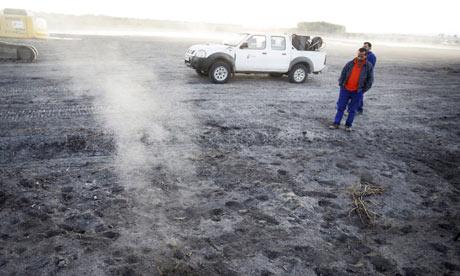
The Spanish Newspaper El Pais publishes a sort interview with me about the ongoing peat fire in Las Tablas de Daimiel.
"El fuego tiene combustible para arder durante años" · ELPAÍS.com. If you are struggling with the Spanish text, try the funny Google translation here.
NOTE: the fire is now being covered by the international media: "Spanish wetland facing destruction as farming starves it of water" (The Guardian, Oct 22 2009)
Monday, 28 September 2009
Personal Remarks about Academic Profession (I)

Seven personal views on some myths about academics (I am an academic indeed!):
I) I do not have 3 month of holidays. Indeed, last year I only took 3 weeks off.
II) I will not be teaching the same courses for 30 years. No. Indeed, I hope to change courses every three or four years to promote the development of new ideas and enrich my knowledge and thus enrich student learning experience.
III) I do not only teach. I am a researcher at heart and that is why I am in the university. It happens that teaching is a very rewarding activity for me too but it is less then half of my motivation and only takes 30% of my time (but that is because I work after hours too much).
IV) I am not stuck in the campus. I travel regularly (once or twice a month) to international destinations for meetings, conferences and presentations. Academia is no longer a lecture-based job and more frequent international mobility is required to succeed in research.
V) I am not, at least not all the time, in an ivory tower. I do solve real life problem. About 5 to 10% of my time is devoted to consultancy job to solve industry problems that come to us for expert advise. 50% of my research time is to solve problems that are taking place right now for which a solution is needed in the medium time. 70% of my sponsoring funds come from industry.
VI) I do care about progress. Research produces the knowledge that is required for tomorrow's technology; as someone said "some of my clients have not been born yet". As a scientist, I believe in the longer term investment for solutions, as an engineer I believe in the short to medium term.
VII) I do not like and I do not support professional endogamy in academic departments. Only the best should be hired. Endogamy is the enemy of long term progress and hinders excellence, at home and abroad. At a few very particular times of crisis and lack of stability, it could be somehow beneficial in the short term. Rarely useful, frequently abused.
extra) To be an academic, apparently, you need a big ego (this results from a survey to the statistically meaningful sample of my colleagues and I)
More later...
Cheers!
G.
PD: I posted this text in my blog at the Institute of Physics, but then realized that it is only open to IoP members!...
Subscribe to:
Posts (Atom)